![]() |
||||||||||||||
| home | subscribe | contact us | advertise with us | feature editorial guidelines | research editorial guidelines | gcsaa.org | ||||||||||||||
|
||||||||||||||
| October 2006 |
|
|||||||||||||
Mighty mite's delight Taskmaster par 5 leads the way at top-ranked nine-hole course in Michigan.
To be unique is not always to be famous. In the case
of the eighth hole at the Dunes Club on the southeastern tip of Lake Michigan,
however, uniqueness and fame are synonymous. Promising precursor Their collaboration in 1989 to fashion a small but stunning golf course in a limited but magnificent setting of wooded dunesland near the village of New Buffalo, Mich., just a few miles over the border from Indiana on the lake’s eastern shore, eventually led to something even more famous a couple of thousand miles away on a rugged piece of Oregon’s Pacific coastline. “If it weren’t for the success of the Dunes Club, there would be no Bandon Dunes,” says Keiser, that property’s owner, crediting the imaginative routing of Dick Nugent and the expertise of the co-construction management of Wadsworth Golf Construction and Sinnott’s ServiScape with the impetus that made it all possible. “No doubt, this is what gave birth to Bandon Dunes. It got the juices flowing to do something bigger and better,” adds Tim Nugent. Challenging blueprint “A lot of the property was derelict, used and abused, and the site was limited to nine holes,” Nugent says. “Mike Keiser found the golf course, and we put it in order from one to nine. We asked him what golf course was his favorite. He said Pine Valley and he added that he really liked National Golf Links, too. So, that laid the groundwork for what the design motif was going to be.” Built according to the standards of those nonpareil venues, the Dunes also features a unique mix of turf — Penncross bentgrass tees, fairways and greens, barely five feet of intermediate fescue rough, then tall fescue at its finest amid imposing waste areas and woodlands. The devil lurks
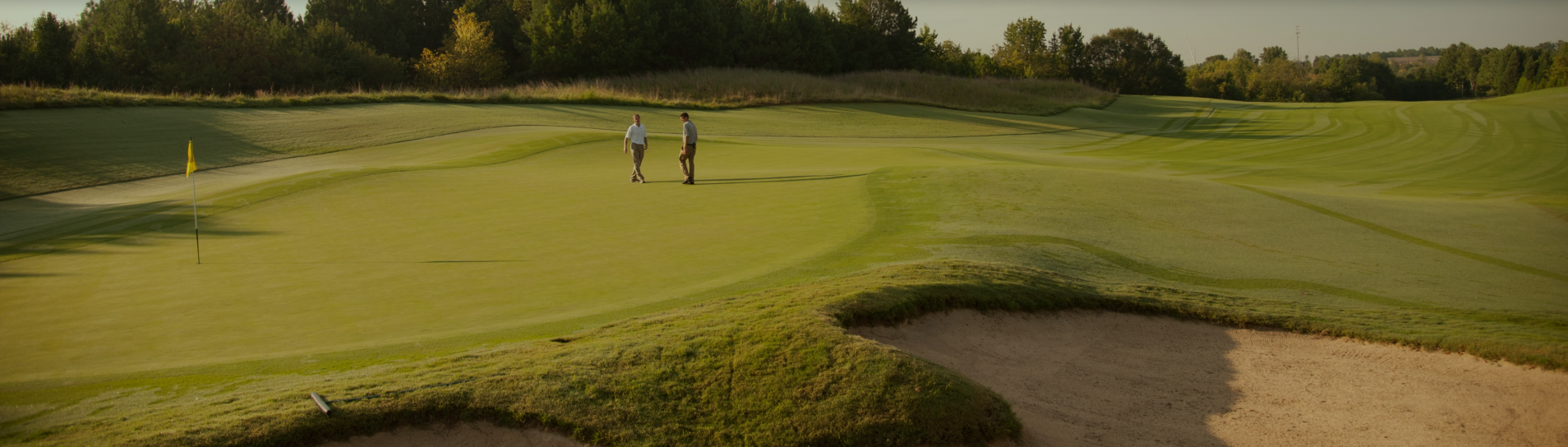
“It gets all the attention; it’s a daunting hole,” says Keiser of the eighth, which opens with a throttled-back tee shot from the highest elevation on the course over a vast waste bunker — dubbed “Hell’s Half Acre” after the original at Pine Valley’s seventh hole — to a split fairway. From there a huge oak guards the route to the green on the second shot, usually forcing a demanding layup that must either be well short of 150 yards to leave room to clear the tree, or beyond and to the right of the intruding foliage. Then the fun really begins, for the most perilous part of No. 8 is its elevated, diminutive green complex, which both Keiser and ServiScape’s course superintendent Alan Southward, say is the heart and soul of the hole. The green, nearly 30 feet above fairway level, is less than 2,500 square feet with about a four-foot collar. Otherwise, it’s surrounded by a dunes waste area, underscoring the prudence of laying back for a high, soft third shot. “I think if the big oak were to blow down or something, more people would try to go for it in two with no better success than they enjoy now because of the green complex,” Keiser says. Adds Southward, an 11-year GCSAA member who’s been at the Dunes (his first head superintendent job) since 2003 after stints at such tracks as Congressional Country Club and Inverness Club: “Not only is the target very demanding, but, believe it or not, that little green is one of the toughest on the course to read — a lot of subtle bumps and breaks.” Walk softly “Basically, it’s communicating with the caddies and using them as guides to direct golfers up different approaches to the green each time,” the Class-A GCSAA member says of the traffic. He also utilizes as much of the green as possible for pin locations while changing cups every day.
Then there is the rest of the story. Nearly two months ago, in mid-August, the Dunes Club shut down until next May to re-grass its greens with the popular Penn super bent, A-4. It’s a move that is expected to offset some of Penncross’s cultural shortcomings, as well as enhance the Dunes Club’s lofty status among golf’s playing fields. “Obviously, the Penncross couldn’t handle the mowing heights the industry is going for now,” says Southward, who gained experience in re-grassing greens during a renovation project at Inverness. “Plus, we had some moss encroachment on some of the surfaces. So, with that issue and the expectations with green speed, it was time. The Penncross also required a lot of verticutting and grooming. I think we’ll definitely benefit from the new variety. It uses less water, it’s more heat and disease tolerant and, along with its appearance and performance under low mowing heights, it will put us ahead of the game.”
|
RECENT issues
|
|||||||||||||