home | subscribe | contact us | advertise with us | feature editorial guidelines | research editorial guidelines | gcsaa.org
June 2007


In this issue

On the Web

Feature articles

The Insider

Departments

Research

GCM blog

GCM's Ask the Experts

Smooth operator

Not much fazes John Zimmers, who is prepping Oakmont for this month’s U.S. Open.

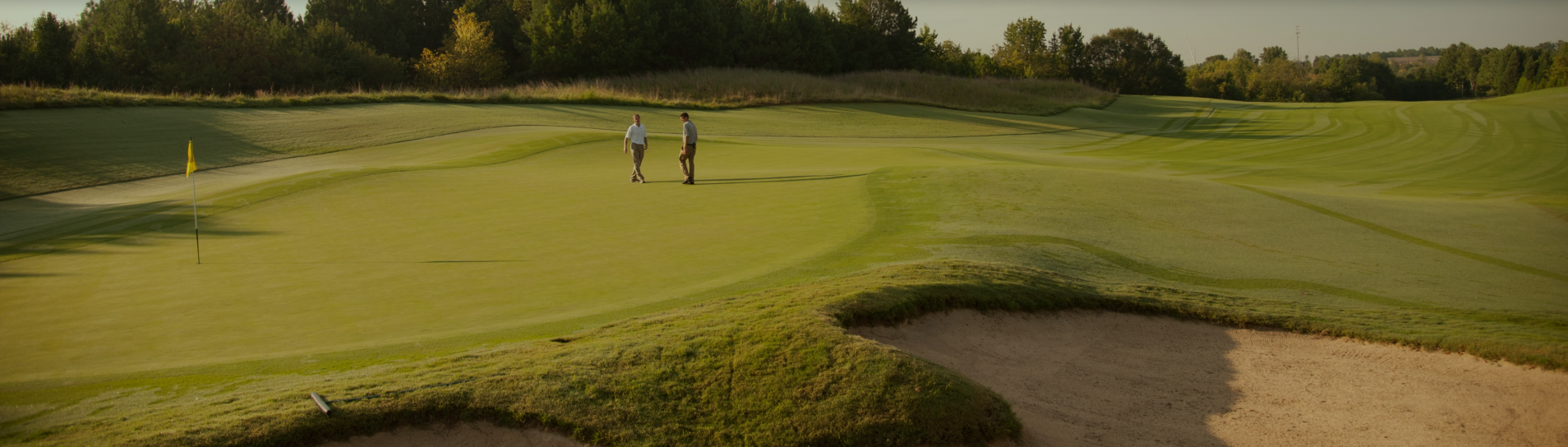
The 358-yard par-4 14th
hole at Oakmont CC.
Photo by Larry Lambrecht

It is an unseasonably cold April morning at Oakmont Country Club, and superintendent John Zimmers is getting antsy.

It’s already mid-morning, but his crew has been stuck in neutral since they began wandering in the door around 6. A stubborn frost covers everything in sight, so instead of mowing, raking and grooming, they wait out the weather inside Oakmont’s maintenance facility, checking and double checking equipment, sipping coffee and chatting about the Pittsburgh Penguins’ playoff hopes.

John Zimmers
Photo by Scott Hollister

Unfortunately, days like this one have been the rule and not the
exception for most of the month of April. The season got off to a flying start in March, when Mother Nature cooperated with warm and dry conditions. But since the calendar changed, winter has made an
unwelcome return to western Pennsylvania, slowing work on the golf course to something just slightly quicker than a crawl.

Clearly, these developments have Zimmers concerned. The digital countdown clock hanging inside the maintenance facility shows just 64 days until the 2007 U.S. Open comes to Oakmont, and Zimmers knows there is more on his to-do list than there are days in which to get all of that work done.

“Honestly, it’s very, very frustrating,” Zimmers admits later. “You want to get a fast start. You have anticipations of getting things going. You realize that time is running short. But this has just been bizarre. We’re supposed to have average temperatures in the 50s, and we’ve been in the mid 30s. We’re off to a slow start.”

But you’d never know any of that from watching the 36-year-old superintendent work his way around the property at Oakmont. Whether he’s mentoring a young crew member or chatting with a longtime club member inside Oakmont’s stately clubhouse, Zimmers exudes nothing but total confidence that preparations for the Open are well in hand and completely on schedule, despite any signs to the contrary.

Don’t mistake his approach for sunshine pumping. The fervent belief in what he says and his unflinching ability to deliver on those promises is a well-honed skill, and they have served Zimmers well in his eight years at Oakmont, whether in the planning for this month’s national championship (June 14-17) or his supervision of one of the most extensive tree removal projects in the history of the game.

“He doesn’t miss much, does he?” laughs Paul R. Latshaw, the veteran superintendent who mentored Zimmers in both Delaware and the Washington, D.C., area.

The famed “Church Pew” bunker that separates the third and fourth fairways at Oakmont. Photo by Larry Lambrecht

Young gun
Latshaw vividly remembers the first time that Zimmers strolled through the doors at Wilmington (Del.) Country Club. A fresh-faced kid almost straight out of high school, the native of State College, Pa., had his eye on a spot on the crew at Wilmington, but almost immediately, Latshaw knew this one was destined for much, much more.

“He just had a quality about him,” recalls Latshaw, a 41-year member of GCSAA. “You can almost sense it in some people. He had goals and was going to make something of his life and his career.”

Needless to say, the job interview was a smash hit, and Zimmers got the job. He wasted little time in moving through the ranks at Wilmington, impressing club officials so much that they pitched in financially to help with his formal education in the turfgrass program at Rutgers.

Yep, the guy who grew up in the shadow of Penn State and its influential turfgrass program ended up at Rutgers, home of another influential turfgrass program. “I always get plenty of grief about that,” Zimmers confirms.

Zimmers and Oakmont’s general manager, Tom Wallace.

In four years in Delaware, Zimmers successfully tackled just about everything that Latshaw could throw at him, and eventually ascended to the position of the club’s No. 1 assistant. And when storied Congressional Country Club lured away Latshaw to help oversee a course renovation and preparations for the 1995 Senior Open and ’97 Open, Zimmers went along for the ride.

“There was no hesitation whatsoever that he was the one I wanted to be my right-hand man,” Latshaw says.

“When you work at a place like Wilmington, a place like Congressional, you begin to wonder to yourself whether you can do everything you’re faced with,” Zimmers says. “But working for a person like Mr. Latshaw, you realize that you can do this and you can do it on a very high level.”

Zimmers (back row, center) and his top assistants — (front row, left to right) Dave Delsandro, first assistant; Brendon Clark, tournament assistant; (back row, left to right) Brett Bentley, first assistant; and Chris Markel, assistant. Photos by Scott Hollister

That confidence came in handy in Washington, D.C., as Zimmers played a key role in converting Congressional’s fairways from bermudagrass to bentgrass in advance of the Senior Open, not to mention the litany of work that regularly accompanies the hosting of a major championship.

But through the quality of both his work and the contacts that he had developed in his time at Rutgers and through his work with the USGA, Zimmers began to attract attention within the industry, attention that would soon present him with one of the toughest decisions of his professional life.

Cleveland rocks
In the fall of 1995, a new Tom Fazio-designed golf course was on the drawing board for suburban Cleveland. They wanted a superintendent on the ground before construction began, and they set their sights on Zimmers.

“It was a Fazio golf course, one owner (Bill Conway, CEO of Best Sand Co.), just a very successful project, and I was there before the first tree came down,” Zimmers says when recalling Sand Ridge Golf Club. “It was one of those situations that you just don’t get to experience very much as a superintendent.”

It was everything that anyone in golf course management could want in his first top job. But Zimmers balked at the opportunity, at least at first. With less than two years until Congressional hosted the Open, he felt he owed it to both the club and to Latshaw to stick it out until the conclusion of the championship.

Latshaw disagreed. “It also might have been because he had been in the profession for such a short time and he was so young that he had some second thoughts about taking such a big step forward. But I never once questioned the fact that he was ready, ready to move on, and if he had stayed with me any longer, frankly it would have been a waste of his time.”

“I remember standing on the 10th fairway at Congressional, and I told Mr. Latshaw that I wasn’t so sure I wanted to leave,” Zimmers says. “He just looked at me and said, ‘No, you’re leaving.’ I was somewhat shocked, but he was really doing it because he knew I had done plenty over the couple of years that I had been there and he knew it was the right time for me to go.”

So he went. Sand Ridge opened to rave reviews in 1998, hosted a U.S. Open sectional in its first full season of operation, garnered Audubon International Signature status and also earned a chapter award in the precursor to GCSAA’s Environmental Leaders in Golf Awards program, the Environmental Steward Awards, in the course’s very first year of eligibility.

It was a close, tight-knit operation at Sand Ridge. Conway treated him “like a son,” Zimmers says, and many times, he felt confident that he would spend his entire career in Cleveland. But again, the accomplishments of both the superintendent and the course were no secret within the industry. And when the head superintendent’s position at Oakmont came available late in 1999, Zimmers found himself at the top of the prestigious club’s wish list.

It was a competitive interview process. But much like he had done on that day many years earlier in Wilmington, Del., Zimmers wowed them. He got the job. He was going home again.

A prestigious stage
It is difficult to overstate the importance of Oakmont Country Club to the history of American golf. Carved out of Pennsylvania farmland near Pittsburgh and set high atop a hill overlooking the Alleghany River, the club has been on the short list of America’s finest layouts since national publications began to track such things.

Since its opening at the turn of the 20th century, Oakmont has hosted more major championships than any other course in the country — seven U.S. Opens, five U.S. Amateurs, three PGA Championships, one U.S. Women’s Open. Arguably the greatest round in championship golf history, Johnny Miller’s 63 in the final round of the 1973 Open, was cardedat Oakmont.

So the profile of the stage that Zimmers was about to step upon came as no surprise to him. He knew he’d have to lead preparations for the 2003 U.S. Amateur, which was already on the books when he came aboard. He also knew from his past experiences with the USGA that where there was an Amateur, an Open wasn’t usually too far behind.

“One of the things we talked about (during the interview) was their efforts to get an Open, and there were questions about my experience and my relationship with the USGA,” Zimmers says. “I had a working relationship previously with several folks with the USGA — Tim Moraghan (the USGA’s director of championship agronomy), Mike Davis (the current senior director of rules and competition for the USGA), Tom Meeks (who formerly held Davis’ position).

“I felt like it was a big factor (in getting the job) and a real positive because I felt like I knew what was going to be expected of us and what they were going to ask us to do.”

Moraghan agrees with that assessment and gave a thumbs-up to Oakmont’s hire.

“I’ve kind of watched John grow up in this industry a little bit going back to our days at Congressional, back as early as 1994,” he says. “He is one of the best. I’m not going to say the best, because there are a lot of great superintendents I’ve dealt with over the years. But you’d be hard pressed to find a guy as good as John.”

A beneficiary of some strong mentoring during his early days in the industry, Zimmers (left) never hesitates lending a helping hand to his staff members at Oakmont. Photo by Scott Hollister

The forest and the trees
Despite the experiences he had crammed into his few years in the industry, despite the recommendations and support he had received from some of the most recognizable names in the industry, nothing could have prepared Zimmers for the scope of the first major project he would help lead at Oakmont, a project that would eventually take on a near-mythic status within the golf industry — the removal of somewhere between 5,000 and 8,000 trees (depending on who’s counting) from the interior of the course.

When club founder Henry C. Fownes first broke ground on Oakmont, he envisioned a layout that would pay tribute to the links-style courses that he had encountered during a trip to Scotland. That meant few, if any, trees, and he picked the site of the club largely because the terrain so closely resembled those Scottish courses.

But in the ’50s and ’60s, at the height of the Keep America Beautiful campaign, the club began a concerted effort to line fairways and surround greens with trees — lots and lots of trees. The changing face of Oakmont never seriously affected its place in the game, but Fownes’ original design intent was greatly muted.

“Every time a new chairman came on board, they planted trees. Every time there was a sale at a local nursery, they planted trees. Spruce, pines, whatever. They planted thousands of trees,” says 26-year GCSAA member Mark Kuhns, CGCS, the director of grounds at Baltusrol Golf Club in Springfield, N.J., who was superintendent at Oakmont from 1991 until 1999.

Eventually, with changing membership and changing opinions, enthusiasm for the trees and the parkland feel they created waned, and the tide began to turn toward reversing this trend. Some hoped for better all-around turf conditions, some hoped to improve playability and others hoped for a restoration of Oakmont’s original design intent. By the late 1990s, all three hopes came together in a perfect storm of sorts.

After several years of fairly minor work that focused largely on trees that were taking their toll on turf health — first under the guidance of Larry Napora, a 24-year GCSAA member who is now the Class A superintendent at Treesdale Golf and Country Club in Gibsonia, Pa., and then in Kuhns’ first several years at the club — the pace quickened considerably by the mid-1990s, most notably following a period where Kuhns and his team tackled tree removal under the cover of darkness, at the sole discretion of Oakmont’s green committee (see “Night moves,” below).

By the time Zimmers arrived on the scene, membership had fully committed to taking tree removal to the next level, a level that few other golf courses had ever attempted to reach. “It definitely came up during the interview process,” he says. “Their ultimate goal was to remove trees and to do a complete restoration.”

But the full extent of what the project would entail didn’t really sink in until it actually began. “I don’t know at the beginning if I was prepared, and I don’t know if (the membership) was fully prepared,” Zimmers says. “We all knew what the ultimate goal was, but it was something we did in phases so it didn’t overwhelm us. When we finished a phase, we’d see what the reaction was, monitor what the area looked like and then move on to the next step.”

Creating a clean slate
Although Zimmers and his team weren’t burdened with having to remove trees covertly like his predecessor, that doesn’t mean there weren’t challenges. Where previous efforts targeted approximately 100 trees a season, Zimmers was now faced with removing three and four times that amount in the same period of time.

“We predominantly did most of the tree work from November through the end of February,” he explains. “When we were hitting it pretty hot and heavy, we’d easily have eight to 12 people working on it, depending on how many trees we were trying to remove. There were several years, different times, when (we were removing) 300 or 400 trees. Some years we did more, some years we did less.”

After more than a decade, the finished product is startling, even for those who have never seen the property before. The only trees left standing on the interior portion of the course are a sycamore and two pin oaks near the first tee, an elm next to the third tee, and another elm between the fourth and fifth holes. And from the steps of the clubhouse, a panoramic vista presents itself, a view that didn’t exist prior to the project.

The notoriety of Oakmont’s tree removal efforts, which is sure to increase as the world’s attention focuses on the club this month, has sparked a movement of sorts within golf, as several other prestigious layouts examine the possibility of tree removal as a means to benefit turf conditions and playability.

“We get a lot of questions (from other courses),” Zimmers says. “We get questions about how you start. We get questions about whether they can come to the course, bring a couple of members of their boards, to see what we’ve done. That’s getting to be pretty common.”

The normal full-time staff at Oakmont generally is between 35-40 employees. For the Open, the crew will number more than 100. Photo by Larry Lambrecht

Full speed ahead
With all of the fuss about the trees, the feature at Oakmont that generally garners the most attention — its greens — has taken an unfamiliar spot in the back seat as the Open approaches. But rest assured, once the tournament begins, there will be plenty of talk about Oakmont’s greens from the players chasing that elusive national championship.

The membership at Oakmont is understandably proud of the course’s Poa annua greens and the treacherous speeds that can be attained on them. On a regular basis, Stimpmeter readings touch 13, and they will probably be in that vicinity for the Open. Zimmers admits they can be pushed higher without too much effort, although don’t bank on that for the tournament — speeds that fast begin to limit potential hole locations.

“I think (the USGA) is very comfortable with the green speeds that we normally run here at Oakmont,” Zimmers says. “We’ve worked very closely with them in how the set-up is going to be, where the hole locations will be and we will continue to review that all the way to the Open and during each day of the championship.”

“We do know each other very well,” says Moraghan. “And a long history like that has some positive results. They know what I’m looking for, I know what they can produce, and there usually isn’t much discussion because this place has always been in incredibly good shape.”

Another agronomic topic that is sure to get its fair share of attention is the roughs and the graduated cuts that will make their second appearance at an Open. Debuted last year at Winged Foot, the concept was the brainchild of the USGA’s Davis and utilizes two different heights of cut for the rough. The areas immediately off the fairways will be cut at about 4 inches. Past that, the cut will be much higher, meaning the farther a shot strays from the short grass, the more trouble it will find.

Last year at Winged Foot, superintendent Eric Greytok handed the rough mowing tasks to one crew member utilizing a specially modified rough unit. Zimmers will do much the same thing this time around and has been working with The Toro Co. on modifications to their rough units that will address the problem of “getting a machine that’s supposed to cut at 2 or 3 inches to cut 6, 7 and 8 inches.”

Zimmers traveled to New York last year to study, among other things, the implementation of the graduated rough concept at Winged Foot. And although he’ll apply much of what was learned during that trip, there are enough differences between the two classic courses — Oakmont has far more bunkers (210 overall, including the famed Church Pews) than Winged Foot — to make the rough setup in Pittsburgh truly unique.

“We’ve had plenty of time to study this, tweak the lines and try to implement it,” says Zimmers. “It’s something that we’ve kind of had to work to get it where we want it to be, and it’s something we’re going to keep working on. I imagine we’ll be tweaking things up to the week of the championship.”


Night moves

Oakmont’s tree-removal efforts first took shape as covert missions conducted under cover of darkness.

The massive tree removal program at Oakmont cleared between 5,000 and 8,000 trees (depending on who’s counting) from the interior of the course. Photo courtesy of Mark Kuhns, CGCS

They would arrive in the dead of night, each fully equipped to do battle.
One team was charged with eliminating the target, another with disposing of the evidence as quickly and efficiently as possible, still another with cleaning up any mess. When they were confident their tracks had been sufficiently covered, they moved on to the next target.

The targets? The trees at Oakmont Country Club. And the teams were composed of elite members of the club’s grounds department, who under the supervision of then-superintendent Mark D. Kuhns, CGCS, made the first forays into a tree removal project that would eventually clear in the neighborhood of 5,000 trees from the site of this month’s U.S. Open.

These midnight raids have been among the most talked-about elements of Oakmont’s tree removal story. Operating at the discretion of the club’s green committee but without a clear mandate from the membership in general, Kuhns’ marching orders came directly from the green committee chairman, and usually only focused on small clumps of trees that the committee wanted removed, seldom more than 10-15 at a time.

The committee always had reasonable justification for requesting a tree’s removal, whether it was to improve turf health, playability or a part of an effort to restore some of Henry C. Fownes’ original design intent. But they knew there was a faction within the membership that would howl at the thought of any tree removal, regardless of how sound the reasoning. So they took the project underground, with most of the work taking place in the pre-dawn hours with just the lights from utility vehicles to guide the way.

“Basically, we figured out how many trees we could get down in a certain amount of time,” says Kuhns, now the director of grounds at Baltusrol Golf Club in Springfield, N.J., and currently GCSAA’s secretary/treasurer. “We’d put tarps down and cut down what we thought we could handle. We had a chipper there, we had a stump grinder there, we had a skid-steer there to take the log away.

“We chipped everything right there, ground the stump up, took out the surface roots. Then we had topsoil and a sod cutter there. We’d fill in with topsoil and tap the sod down. We had two Packer sweepers around so if there was any sawdust left that got off the tarp, we’d sweep that up. There were no leaves left, nothing. We had a quality control person there to make sure that every leaf, every ounce of sawdust was gone. We’d go back through with rakes to fluff up the grass, and it was like we weren’t even there.”

Kuhns admits that being so secretive about these forays into tree removal left him conflicted, especially professionally. While he regretted keeping the work being done from the membership in general and knew it would be far less complicated (and with better hours) with full membership backing, he certainly harbored no qualms about dutifully honoring the wishes of his green committee.

“It was never my decision, other than to offer an opinion as it related to the health of the turf,” he says. “However they wanted their course to look, with or without trees, was their decision to make.”

Eventually though, Kuhns and his crew were able to shed the nighttime work and get a little sleep as the idea of a full-fledged tree removal program began to gain traction within the membership. Based on that now widespread support, Kuhns slowly ramped up his team’s efforts until departing Oakmont in 1999, leaving the majority of the heavy lifting for John Zimmers to supervise.

And although he hasn’t seen the new-look Oakmont in person, Kuhns is still stunned at the extent of the project that his team of tree specialists began years earlier under the cover of darkness.

“I never dreamed they were going to cut them all down,” Kuhns says. “I just thought it was something where it was going to create some nice little vistas, areas where you could see the green from the tee. I never in my wildest dreams thought they would cut down almost every tree at Oakmont.”

—S.H.


The heroes of Oakmont

Since its opening in 1903, Oakmont Country Club has hosted more of golf’s major championships than any other course.

U.S. Open Championships
Men’s

1927 — Tommy Armour
1935 — Sam Parks
1953 — Ben Hogan
1962 — Jack Nicklaus
1973 — Johnny Miller
1983 — Larry Nelson
1994 — Ernie Els
Women’s
1992 — Patty Sheehan

U.S. Amateur Championships
1919 — S. David Heron
1925 — Bobby Jones
1938 — Willie Turnesa
1969 — Steve Melnyk
2003 — Nick Flanagan

PGA Championships
1922 — Gene Sarazen
1951 — Sam Snead
1978 — John Mahaffe


On the web

Oakmont Country Club. The club’s official home page offers notes on the history of Oakmont, a virtual tour of the course and information about the U.S. Open.
www.oakmont-countryclub.org

The U.S. Open. The official site of the U.S. Open, operated by the USGA.
www.usopen.com

GCM. Veteran blogger Seth Jones will go behind the scenes to report on maintenance activities during the days leading up to the U.S. Open.
http://gcm.typepad.com/

Pittsburgh News-Gazette. The major daily newspaper in Pittsburgh has a dedicated site of its coverage of the U.S. Open, which included an in-depth feature on the course’s tree removal project.
www.post-gazette.com/sports/usopen


Scott Hollister is the editor of GCM.

RECENT issues

May
2007

April
2007