home | subscribe | contact us | advertise with us | feature editorial guidelines | research editorial guidelines | gcsaa.org
August 2008


In this issue

On the Web

Feature articles

The Insider

Departments

Research

GCM blog

GCM NewsWeekly


A real Ross

Prepped by a savvy superintendent, Oakland Hills’ South Course remains true to its original design as it welcomes the 2008 PGA Championship.

Oakland Hills CC’s golf course manager, Steve Cook, CGCS, MG.
Photo © Fabrizio Costantini

A host of the world’s best golfers will get a hearty taste of legendary golf course architect Donald Ross this month, including the field in the 90th PGA Championship at Oakland Hills Country Club in the northwest suburbs of Detroit. Oakland Hills is one of three venues hosting the game’s major events being played on Ross designs in August — the others being the U.S. Senior Open at the Broadmoor Golf Club in Colorado Springs and the U.S. Amateur at Pinehurst (N.C.) No. 2 (see Page 20). The championship at Oakland Hills is the third PGA the club has staged on its South Course in its nine decades, to go along with six U.S. Opens, two Senior Opens, a Ryder Cup and a Men’s Amateur.

Renovations to Oakland Hills’ South Course were balanced to stay abreast of the game’s changing physical characteristics without losing the character of the original Donald Ross design. Pictured is the 191-yard, par-3 13th hole. Photo courtesy of the PGA of America

Savvy superintendent

Steve Cook, CGCS, MG, has been the golf course manager at Oakland Hills the past dozen years and is no stranger to the trappings of major competitions that are so much of the historic venue’s heritage. In 1988, Cook helped prepare for the U.S. Senior Open as a course superintendent at Medinah Country Club in his native Illinois, and in a whirlwind span at Oakland Hills, he prepped for the 2002 Amateur and the 2004 Ryder Cup matches.

He also had relatively short stints as superintendent at Golf de Joyenval in Paris, France (a prelude to Cook earning certification as an international Master Greenkeeper in 2001), and at the Wakonda Club in Des Moines, Iowa, before taking over at Oakland Hills.

Respectful renovations

The South Course is unique in that it still features many of the basics from when Ross created it in 1918 on the old Miller farm near the village of Bloomfield Hills, most notably the old master’s trademark undulating, multitiered greens. Cook also points out that Ross’s routing has remained generally unchanged over those 90 years, despite a series of enhancements by Robert Trent Jones Sr. leading up to the 1951 U.S. Open, Arthur Hills in 1987 and Rees Jones in 2006.

“Only one green has ever been extensively changed or moved ... that’s very unusual,” says Cook, a 26-year GCSAA member. “Last summer we had a guy stop by who was on the grounds crew in 1950 when Trent did his work on the golf course. We asked him if any of the green surfaces were redone because that’s always been the big question here. He said no, that they’re the original Donald Ross surfaces.”

RTJ’s son, Rees, was especially cognizant of the layout’s lasting features during his upgrade two years ago.

“Oakland Hills is one of those wonderful rolling pieces of property where the holes fit like a glove,” Jones said in a PGA media release regarding Ross’s knack for natural elevation changes and contours, and his own efforts to maintain the original design and RTJ’s reinforcement.

“This course meant the most to my father,” Rees said, adding that the request to guide the 2006 renovation “was the call I was waiting for my whole life.”

Major championships are nothing new to Cook (center) and members of his crew at Oakland Hills. He prepped the South Course for the 2002 U.S. Amateur and the 2004 Ryder Cup, and readied Medinah (Ill.) CC for a U.S. Senior Open in 1988. Photo © Fabrizio Costantini.

Modernizing a classic

Kerry Haigh, the PGA’s managing director of championships, says the culmination of the projects at the South Course points to the long-range foresight of the powers that be at Oakland Hills to stay abreast of the game’s changing physical characteristics.

“It’s been a great asset on behalf of the club to continue to make Oakland Hills an even better facility for major championships than it already was,” Haigh says. “We’re excited to be coming back there to host the PGA Championship. It’s going to be a great challenge for the players. I’m very much looking forward to it.”

A crew member makes an early morning pass on the practice putting green during the Ryder Cup. Photos courtesy of Steve Cook

The most recent remodel of the South Course was a high-profile continuation of work Cook had been involved in since 1999. For the most part, Jones added a good quarter of a mile in length, from the 6,974 yards the par-70 layout played at in its most recent U.S. Open in 1996 to its present-day 7,439 yards. In that process, fairways were narrowed and many of the South’s whopping 135 bunkers were redone and relocated to accommodate the modern game.

“We’re now the same yardage as Augusta, but we’re a par 70,” Cook notes.

Cook with the PGA Championship trophy, which will be awarded following the tournament, Aug. 7-10.

“We also have what we think is the best finishing hole in golf,” he says of the 498-yard, par-4 18th, complete with myriad Ross/Jones challenges.

Flexing new muscles

Even so, by today’s power golf standards, the South Course isn’t exactly the “monster” that Ben Hogan famously dubbed it after he won that ’51 Open. But it will be formidable, nevertheless, thanks to key changes.

“We’ve made our par 3s longer and tougher (No. 9 checks in at 256 yards and No. 17 at 245, for instance), narrowed the fairways, really paid attention to the landing areas, and the bunkers are very penal and very hazardous,” says Cook. “It’s placed a premium on tee shot accuracy. Plus, it’s so difficult to get to the right spots on the greens — the pin locations shrink them because of the undulations and shelving.”

Cook says there was a method to the increase in length.

“We have Ben Hogan’s club selections from the 1951 Open and he hit a lot of long irons into the greens,” he says. “Our objective was to go back to that philosophy. I think we did that — certainly on the par 3s (the four of them average a bit over 222 yards).”

The most recent renovation of Oakland Hills’ South Course by architect Rees Jones stretched the layout to 7,439 yards, narrowed fairways and remodeled and relocated many of the layout’s 135 bunkers.

The Ides of August

The tournament dates (Aug. 7-10) are a week earlier than PGA tradition, which didn’t do Cook and his staff any favors. Early August is historically the hottest time of the year and usually wet, too, with late-summer rains coming up from the southwest, plus the effects of at least three of the Great Lakes that surround the region.

“It is what it is. We’re assuming it’s going to be hot, we’re assuming it’s going to rain, we’re assuming it’s going to be humid,” Cook says, adding that he has made sure there are plenty of hand-watering hoses on hand, as well as extra squeegees and extra pumps. A tree crew will also be on standby.

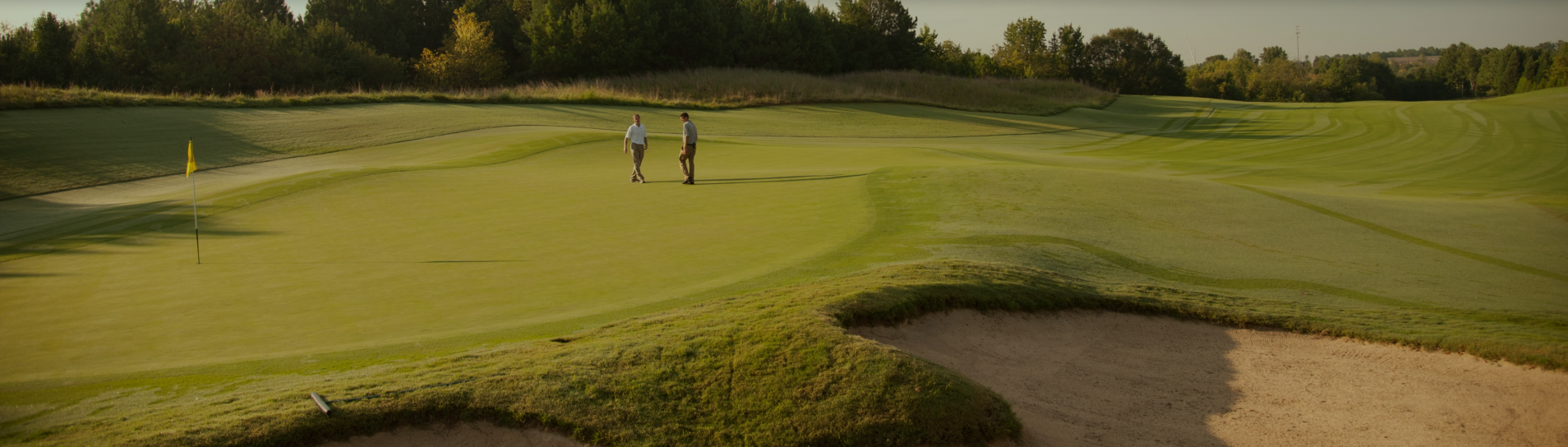
The putting green on the 491-yard, par-4 8th hole still features the undulations that are a Ross trademark. Photos courtesy of the PGA of America

Agronomically, the South is bentgrass/Poa annua tee through green, and a lot of aerifying has been going on — tees and fairways, plus deep-tining in the landing areas, while the greens received a water-injection aerification in early June. The green speeds haven’t been up to where Oakland Hills’ members like them as Cook and South Course superintendent Ben McGargill, a six-year GCSAA member, brought them along slowly through the summer. They’ll be plenty fast enough, especially for Donald Ross surfaces (about 12 on the Stimpmeter) come tournament time.

“We can do a lot of things with our greens if the water stays away,” Cook says. “They’re really good when they’re dry.”

Because of the stormy, cool spring that ran through the Midwest, the bluegrass/ryegrass/fescue rough was late in filling in, but as the championship approached it was a hardy 4 inches.

One of the biggest chores for the bunker crews has been reaching an acceptable consistency in the sand hazards because there are so many of them and, thus, so many in play.

“Steve Cook and his staff are very experienced and very skilled,” Haigh notes. “Certainly August in every year is a challenging time to get a golf course in its best condition — most superintendents will tell you it’s the most difficult time to manage cool-season grasses. With that said, considering the expertise of Steve and his staff, we expect the course to be in outstanding shape for the championship.”

Cook will have a veteran crew at his disposal as he preps the South Course (pictured here is the 449-yard, par-4 7th hole) for this month’s PGA Championship, a large percentage of whom were on hand for both the U.S. Amateur and the Ryder Cup.

Super staff

The makeup and quality of the maintenance staff is one base Cook has had covered for a long time. He has assembled a crack crew, both on the South Course and the North Course. Many of them went through the Ryder Cup and U.S. Amateur with him. In mid-July, the North Course closed nine of its holes and about half of course superintendent and seven-year GCSAA member Ron Bentley’s staff joined the efforts on the South, which closed for play at the same time.

“We’ve got a great staff. I’ve spent a lot of my time in the last several years trying to hire the right people and train them,” Cook says. “Including myself and the two course superintendents, we have 12 full-time people here with degrees in turf, plus this year we have 11 college interns. There’s lots of input, lots of ideas ... it keeps you on your toes and makes you look at things with a critical eye. It’s all good.”

Earlier this year, however, there were some serious concerns about the general maintenance staff. Cook has relied on the H-2B program since 2001 to provide 30 to 40 seasonal workers. But when Congress failed to pass an extension to the returning worker exemption by last Sept. 30’s deadline — and still hasn’t nearly a year later — Oakland Hills was caught in a severe labor pinch at the worst of times.

“We did have to scramble, but today we are fully staffed according to plan with local labor,” Cook says. “Luckily, we have hired a tremendous staff of local retirees and college, high school and migrant labor. I am very pleased with where we are from a staff perspective. Yes, we do miss our seasoned migrant laborers who were experienced in tournament prep. But I’m really proud of the guys we’ve got here now. I’m very confident that we have the workers in place to have a great championship.”

Percolating prep

Cook and many of those around him have learned much about major events in recent years, including the all-important little details. Such as? “Believe it or not, and no joke, to have coffee ready earlier,” he says. “In the Ryder Cup, the caterer didn’t have it here on time (4:30 a.m.) and the volunteers and crew got pretty antsy.”

“On the golf course, the Ryder Cup went really well for us,” Cook continues. “We were well prepared. That taught us that to be prepared and organized is important. But also, we learned to slow down, have some fun, smell the roses so to speak, and keep the stress level low and focus on the things we can control. We can’t control the weather and some things like that, but we can control all the little details and how well we do our job.”

Cook likes to have most of the hay in the barn well ahead of time, so the Oakland Hills staff has spent much of the past couple of months putting on the final touches, such as sodding and seeding, and refining the bunker work, while the tournament infrastructure and corporate trimmings sprouted up around them.

“The real prep for these events is done the two or three years before,” he says. “Our objective was to have all the projects that we needed to have completed for course maintenance done in the fall of 2007, so in 2008 all we’ve really had to do is some tweaking, growing grass and getting the bunkers in shape — maintain what we have.”


Terry Ostmeyer is the senior staff writer for GCM.

GCM archive