home | subscribe | contact us | advertise with us | feature editorial guidelines | research editorial guidelines | gcsaa.org
June 2008


In this issue

On the Web

Feature articles

The Insider

Departments

Research

GCM blog

GCM NewsWeekly

GCM's Ask the Experts

Finishing touch

The job of getting San Diego’s crown jewel ready for this month’s U.S. Open fell to a longtime veteran of
municipal golf and former GCSAA president — who’s also the association’s new CEO.

The city of San Diego turned to longtime municipal golf administrator Mark Woodward, CGCS, to prepare the South Course at Torrey Pines for this month’s U.S. Open. Photo by Gary Newkirk

On a crisp and slightly hazy day in late March, exactly 71 days before the first tee shot of the 2008 U.S. Open, the dream of the South Course at San Diego’s Torrey Pines hosting one of golf’s premier events is beginning its slow but steady march toward reality.

Hospitality tents are springing up on the facility’s North Course, which is yielding much of its grounds to tournament infrastructure. Workers are staging poles, wires and fencing around the South Course for concession stands and restroom areas. And a few days earlier, the maintenance team began implementing its first Open-centric agronomic activity in the form of the USGA-requested graduated cut on the course’s rough.

Mark Woodward, CGCS, golf operations manager for the city of San Diego, has seen this all before at countless other Open venues he’s visited. But this one belongs to him, and as one of the few people who understands how much went into getting not just Torrey Pines but the whole city golf department to this place in time, Woodward exhibits a clear sense of satisfaction — or maybe it’s relief? — as he guides a visitor around the oceanfront property.

GCM blog hits the U.S. Open
Want to read more about Torrey Pines’ preparations for the 2008 U.S. Open? Then check out GCM’s blog, From the Desk of GCM, during tournament week, June 9-15. You’ll be able to read more about the course’s efforts to prepare for the Open, stories that didn’t make it into this month’s preview, and behind-the-scenes reports about maintenance activities on the South Course. Coverage begins Sunday, June 8.

When the 29-year member of GCSAA first came to Southern California three years earlier, he brought a unique skill set to the task of leading Torrey Pines’ quest to become the first truly municipal facility to host a U.S. Open. The grandson of a noted superintendent, a veteran of more than three decades in municipal golf and parks administration and a dedicated industry volunteer, he had done and seen much in his career.

Despite all of that, it wasn’t long before he realized he hadn’t actually seen and done everything in golf. Just in his first year on the job, Woodward found himself embroiled in a political firestorm surrounding his controversial new business plan for the city’s golf business, fighting an almost chronic case of understaffing, overseeing physical changes to not only the golf courses under his watch, but also the physical structures attached to them and preparing for a PGA Tour event, the Buick Invitational.

Oh, and there was also a little matter of putting the finishing touches on the South Course’s preparations for the U.S. Open.

“It was pretty scary,” Woodward admits now, “and I did ask myself on numerous occasions during that first six months what I had gotten myself into. But I’m the type of person that wants to tackle a challenge like this and get involved in a U.S. Open. And I could see the potential in this golf course and in this operation. That’s why I came here.”

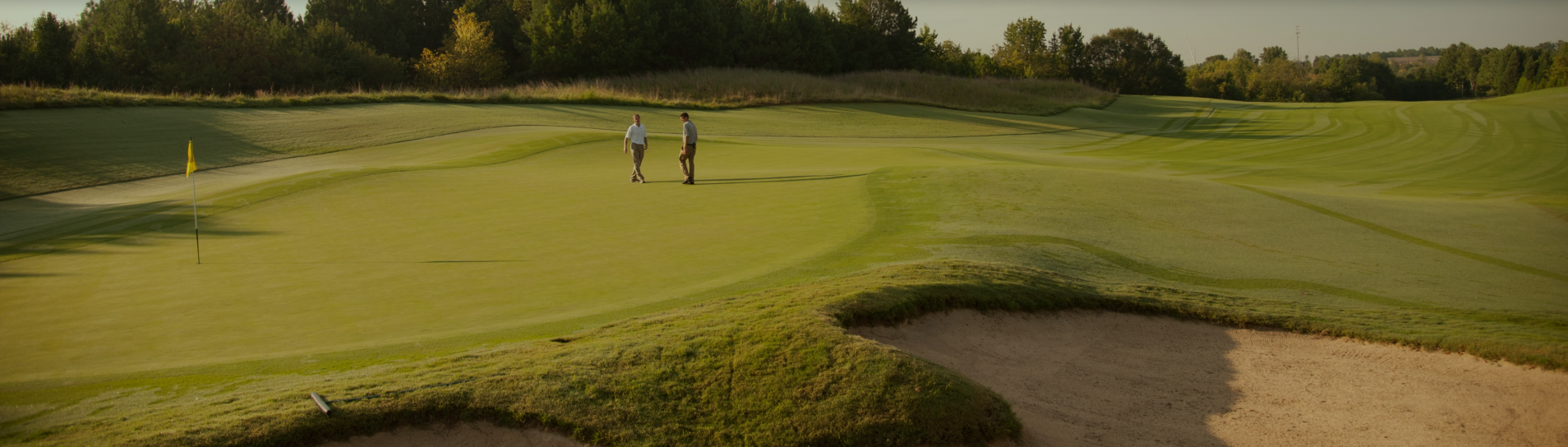
Top: Revamped in 2001 by architect Rees Jones, Torrey Pines’ South Course will be stretched to almost 7,600 yards for the U.S. Open. Pictured here is the par-4 fourth hole. Copyright USGA/John Mummert
Bottom: Woodward (left), GCSAA’s 2004 president, works side by side with another former association president, Jon Maddern, CGCS, president in 2003 and San Diego’s assistant golf operations manager. Photo by Scott Hollister

Meant to be?
Woodward’s roots in the game of golf run deep, so deep that some might characterize his star turn in San Diego — and maybe his recently announced new job as the CEO of GCSAA (see “Meet the new boss” on Page 60) — as an act of destiny. His grandfather, Jay, was a legendary superintendent in the Phoenix area, a winner of GCSAA’s Outstanding Service Award in 1976 and one of just three superintendents in the Arizona Golf Hall of Fame, and the junior Woodward turned years of experience at his grandfather’s side into a degree from Arizona State, and soon thereafter, a job as an assistant superintendent at Mesa, Ariz.-based Dobson Ranch Golf Course.

Two and a half years later, Woodward climbed into the captain’s seat at Dobson Ranch. In 1987, when the city of Mesa opened the nine-hole Riverview Golf Course, he began supervising maintenance there as well. And before all was said and done, he was promoted to the job of parks and recreation administrator for the city, spending 31 years overseeing 27 holes of golf, the spring training home of the Chicago Cubs, a cemetery, tennis facility and park ranger program.

During those years, he also became determined to give back to the industry that had given him so much. He dove into local service as a member of the Cactus and Pines GCSA, and eventually won a seat on GCSAA’s national board of directors, culminating that stint with a term as GCSAA’s president in 2004.

“I want to do what I can for the industry,” he told GCM before beginning that presidential term. “I have a passion for it.”

But in that same story, he also offered a sneak preview into what his future might hold, telling the magazine that he intended to retire from his position in Mesa at the end of his GCSAA board service. “I’m ready to move on and do something different in the golf industry.”

And that’s where our story begins, less than 48 hours after he turned in his gavel at the 2005 Golf Industry Show in Orlando, with Woodward and his wife, Amy, rolling out of Phoenix toward San Diego and what would become the most challenging — and rewarding — three years of his long and storied career.

The fairways, tees and roughs on the South Course at Torrey Pines have been converted to kikuyugrass, a species which thrives in the course’s coastal location and will be lightly overseeded where needed for the Open. Copyright USGA/John Mummert

A long, winding road
A few months before that road trip, Woodward got his first look at just how significant the task in San Diego would truly be. In town to interview for the position he would ultimately accept, he and his wife decided to take a spin around town to get a sneak preview of the golf properties he would manage if he were offered the job.

What they saw was underwhelming at best. A damaged roof on the clubhouse and weeds in the planters at Balboa Park Golf Course. Boarded up doors and windows at Mission Bay Golf Course, a property the city had just rescued from a delinquent former owner. And at Torrey Pines, broken street lamps and a crumbling parking lot welcomed them to what was considered the crown jewel of the city’s golf offerings.

Those opinions didn’t change much when Woodward took his first full tour of the property at Torrey Pines after starting in San Diego. “I called my new boss (Ellie Oppenheim, the park and recreation director for the city) on the phone and told her I wouldn’t give her $25 for that experience,” he says. “It was a quintessential municipal golf operation. Now, there is nothing wrong with that. But this golf course wasn’t being maintained at any level of frequency that would get it in championship condition. I knew right away that we had a lot of work ahead of us.”

Now, to be fair, there was plenty right about what was happening at the South Course. Rees Jones had overseen a full renovation of the course in 2001 (so extensive that he told the San Diego Union-Tribune the work was basically “a new golf course on the same site”) to put it on a championship footing. And the team in place when Woodward arrived did have experience in professional tournament prep, thanks to the PGA Tour’s annual visit to the South Course for the Buick Invitational.

But the key now, as Woodward would explain, was taking that next step. And he knew that step would be a huge one. “Rees had given us a championship golf course,” Woodward said. “We just needed to maintain it and live up to the vision he had for this course.”

Getting down to business
Before he could turn his full attention to the agronomic side of the preparations on the South Course, the dollars and cents of the golf operations in San Diego took priority. At the direction of Oppenheim, Woodward was to prepare a new five-year business plan for the city’s golf courses.

Top and center: Rees Jones’ renovation of the South Course in 2001 didn’t end all the work at Torrey Pines. Pre-Open projects included some sodding and the
construction of new cart paths. Photos courtesy of Mark Woodward
Botom: The 14th hole on the South Course. Copyright USGA/John Mummert

“Financially, they were in bad shape,” Woodward explains. “They were making money, but nobody knew how much, where it was really going and what it was used for.”

So with his trusty calculator at his side, Woodward got to work. Along with his assistant at that time, Mark Marney, they studied expenses and revenues, conducted a “cost-per-round” analysis, developed a mission and vision statement for the city’s golf operations along with a list of primary goals and guiding principles and undertook a benchmarking study of comparable municipal golf outfits.

From that number crunching came the first draft of the business plan, a plan that Woodward was proud of and one that he was confident would put the city’s golf business on solid footing for years to come. He did propose altering the way coveted tee times on the South Course were allotted and raising green fees across the board, but he was still comfortable with the plan.

He soon realized he was in a distinct minority. Public reaction to the plan bordered on hysterical. Longtime stakeholders in the city’s golf properties, who had enjoyed favorable green fees and their pick of choice tee times at Torrey Pines for many years, didn’t like the prospects of losing those perks, didn’t like plans for a new clubhouse at Torrey Pines and especially didn’t like the fact that all of these proposed changes were coming from a newcomer like Woodward.

As the business plan went through first one revision and then another in an attempt to soothe some of those concerns, the story found a regular home on the television news and the front page of the newspaper. Many times, the debate turned ugly, with Woodward the frequent target of nasty personal comments and, on one occasion, an anonymous death threat.

“It was quite a year, very stressful,” Woodward says. “I ended up getting sick a few times because of the stress. My wife was probably more concerned than anyone because she was on the outside hearing all the stories, reading the newspaper, hearing about the death threats. And she was seriously wondering whether we were safe, whether we needed to go back to Arizona.”

A new ally in City Hall
At the same time, San Diego’s city government was going through its own period of upheaval. Racked by corruption (two members of the city council, including the deputy mayor, were convicted of extortion, wire fraud and conspiracy to commit wire fraud) and mismanagement of the pension fund for city employees (Mayor Dick Murphy resigned in July 2005 as a result of the scandal), the city looked to a new mayor, Jerry Saunders, who took office in January of 2006.

The change turned out to be a godsend for Woodward and the golf operations department. “I got called into his office in March of ’06, and I really had no idea what he wanted,” Woodward says. “He told me, ‘Mark, I’m hearing more about golf and the business plan than I am about a $1.4 billion pension plan deficit. I want to know what’s going on.’”

So Woodward explained the situation from his viewpoint and gave the new mayor a copy of the business plan to review. A week later, he heard back from the mayor. He liked what he had read, and suddenly, Woodward had a new ally in his corner.

“He was really the one that got this thing going,” Woodward says. “He called in all the stakeholders — the Lodge (at Torrey Pines), the Hilton (another hotel near the South Course), the pro shop, the brokers, the men’s club, the women’s club, all these people — and told them that the plan belonged to him now. It was the mayor’s business plan, not Mark Woodward’s, and if there were any questions, they were to come to the mayor’s office.

“Right then, my life changed.”

Not surprisingly, the business plan was soon officially ratified by the city. And in the first year following its adoption, the city brought in $3 million more from its golf operations than it had in the previous 12 months.

And those opponents who had so vocally challenged Woodward over the business plan? Many of them are now his biggest backers.

“It’s totally been reversed,” he explains. “The men’s club has become one of our biggest supporters, really embracing the things that we’re trying to do. They were one of the loudest opponents during the debate about the business plan … but now they had 80 volunteers hand-raking bunkers during the Buick this year. They have 200 volunteers who are going to help marshal the first and 18th holes at the Open. They have become very, very supportive.”

So some 15 months after it began, the saga was over. The real work of preparing for the U.S. Open, now less than 24 months away, could finally begin.

The maintenance team at Torrey Pines utilized an aggressive aerification program on the course’s greens to speed their conversion from bentgrass to Poa annua. Shown here is the approach into the fourth hole. Copyright USGA/John Mummert

Getting after the greens
Just because the political turmoil was behind him didn’t mean that all of the challenges that go into preparing a course for a U.S. Open went with it. As Woodward says, “If you believe that it takes 3 to 5 years to get a normal golf course ready for a championship, it felt like we were 15 years behind the eight ball. We just really had to get in gear and go.”

The South Course’s greens topped that to-do list. Planted with bentgrass back in 2002, the putting surfaces were gradually giving way to Poa annua and had developed a thick thatch layer. Players at the Buick Invitational had complained about their soft, spongy condition, and Woodward, along with representatives of the PGA Tour and the USGA, knew something had to be done.

Collectively, the decision was made to yield the greens to the advancing Poa and, in fact, to help the grass along with its conquest. As a result, the South Course underwent an aerification program as aggressive as any in the country. Designed to not only relieve that thatch layer but also to spread the seed heads of the Poa so they would multiply faster, the South Course greens were aerified 22 times between 2005 and April 1 of this year.

The plan seems to have worked. Prior to the first aerification, a test was conducted that revealed Poa made up between 15 and 19 percent of the putting surfaces on the South Course. After the first year of the plan (which included about a half dozen aerifications), that number rose to 40 percent. The most recent test had that percentage in the high 90s.

“Now that we’ve got the surface where we want, we can really start managing the Poa on the greens … control the seed heads, control the rate of growth and all of that stuff,” Woodward says. “The players at the Buick this year were happy, the USGA is very happy with where we are right now and with the speeds (look for Stimpmeter readings of around 13 for the Open) and firmness that we can now achieve.”

Making the switch
There were a few more hitches in a similar plan as it related to Torrey Pines’ fairways and roughs. Traditionally, the South Course was carpeted by what some might call “a municipal mix” — a little Poa here, some kikuyu over there, a pinch of ryegrass and bermudagrass on the areas in between — and the facility clearly adhered to the “if it’s green, mow it” mentality, Woodward says.

That wasn’t going to be good enough for a U.S. Open, and the USGA supported the development of a monostand of turfgrass on the South Course. After much examination, debate and discussion, the powers-that-be decided that kikuyu would be that turfgrass. “We’re right on the coastline here and it grows prolifically,” Woodward says. “The weather here is perfect for kikuyu.”

The conversion plan called for two herbicide treatments of the fairways and roughs in 2006 and 2007, with Kerb 50W going down in 2006 and a wall-to-wall treatment (greens excluded, of course) of Revolver in 2007. The first did a number on the Poa, the second on pretty much everything else, a scenario that created more than a few anxious moments for the management team at Torrey Pines.

But as the weather warmed in the spring and early summer of 2007, the kikuyu began a slow but steady recovery. By the time USGA officials made a site visit on the Wednesday following the completion of the U.S. Open at Oakmont, “we had recovered fully from that second application, and the fairways were just perfect,” Woodward says.

Unfortunately, they wouldn’t stay that way. An agronomic perfect storm late last summer that brought together a case of the turf disease kikuyu decline, mild and scattered instances of scalping from some new mowers (complete with freshly sharpened blades), a period of drought and the temporary loss of a pump station waylaid the kikuyu, leaving the South Course with patches of dead or dying grass.

“Rightfully so, the USGA was worried and the PGA Tour was worried, because they were concerned about playing conditions for the Buick in January,” Woodward says. “So we collectively decided to overseed the fairways with ryegrass.”

That strategy did the trick. Playing conditions were fine for the Buick, and Woodward expects the kikuyu to be the dominant grass for the Open, with fairways cut at 7⁄16 inch and roughs trimmed anywhere from an inch and a half in the first cut immediately along the fairways to as deep as 4 inches in the final cut of rough alongside the gallery ropes.

“Ultimately, the idea was for this to be a kikuyugrass golf course,” Woodward says. “But we’ve decided that since the PGA Tour is really our long-term client here (with the Buick Invitational), we need to have that kikuyugrass base and then lightly overseed where it’s needed.”

The team who will be heading maintenance efforts at the U.S. Open (from left to right): Wayne Carpenter, the superintendent at Torrey Pines’ North Course; South Course superintendent Candice Combs, CGCS; Maddern; Woodward; Bill Sinclair, the assistant superintendent on the South Course; and Ken Robers, CGCS, assistant superintendent on the North Course. Photo by Gary Newkirk

A team effort
The task of readying the South Course for the U.S. Open and putting together a team capable of producing those kinds of conditions has clearly tested Woodward. There was a basic elevation of maintenance practices (such as moving from a three-times-a-week mowing schedule to everyday) to install, there was regular turnover within the maintenance department to manage, and the previously mentioned political skirmishes to fight.

That’s why Woodward takes advantage of his role as the primary spokesperson for all matters relating to golf course management for both the Open and the Buick to credit the efforts of a team of GCSAA members, three of them certified and one a former president of the association, assembled almost exclusively to get the South Course ready for this month’s week in the spotlight.

Heading that list is Jon Maddern, CGCS, who serves as the city’s assistant golf operations manager and was GCSAA president in 2003. Maddern joined the team less than a year ago, and had one clear charge when he was hired — focus on the agronomics. “With me having to focus on the political stuff, the media and all of that, I needed that,” Woodward says. “That’s his role.”

The individual course superintendents at Torrey Pines also find themselves in the middle of the fire. Candice Combs, CGCS, the superintendent on the South Course and a 13-year GCSAA member (Combs’ role at Torrey Pines was featured in “Right place, right time … right woman,” in the June 2006 issue of GCM) and Wayne Carpenter, the North Course’s superintendent and a 10-year member of the association, are the key eyes and ears on the ground for both

Woodward and Maddern, making sure the day-to-day work of both maintaining Torrey Pines and preparing for the Open flows smoothly.
Woodward also tips his cap to the three men who carry the title of assistant superintendent at Torrey Pines — Bill Sinclair, a one-year GCSAA member, on the South Course; Ken Robers, CGCS, a 21-year member, on the North Course; and Patrick Holden, a 16-year member, who handles special projects on the entire property — and his business manager Eileen Bangalan (“she really keeps all of this going,” Woodward says).

“I’m very fortunate to have been able to assemble the team of staff members we currently have,” he says. “All of them have risen to the occasion, and their hard work and dedication is paying off. No one person could have pulled this off by himself. This is truly a case where a team of people has come together who all had the mindset that we were simply not going to fail. It is a true testimonial about the type of people in the golf business.”

That tight-knit team won’t last long after the Open, though. Just under three weeks after the last putt drops, Woodward will assume his new duties as GCSAA’s CEO. Some might speculate that the move is directly related to the trials and tribulations he slogged through over the last three years, but he made it clear to city officials from the start that he would not be long for the position following the Open (the CEO opening at GCSAA was just a case of good timing, he admits) and that all of the struggles the department went through to reach this point in time were well worth it.

“There was a lot of pain getting where we are now and going through that process,” Woodward says. “But it has all paid off. We’re ready to go.”


Scott Hollister is editor of GCM.

RECENT issues

May
2008

April
2008