home | subscribe | contact us | advertise with us | feature editorial guidelines | research editorial guidelines | gcsaa.org
April 2009


In this issue

On the Web

Feature articles

The Insider

Departments

Research

GCM blog

GCM NewsWeekly


Go brown and save green

With the economy down, fuel prices up and the
environment on everyone’s mind, has there ever been a better time to go brown?

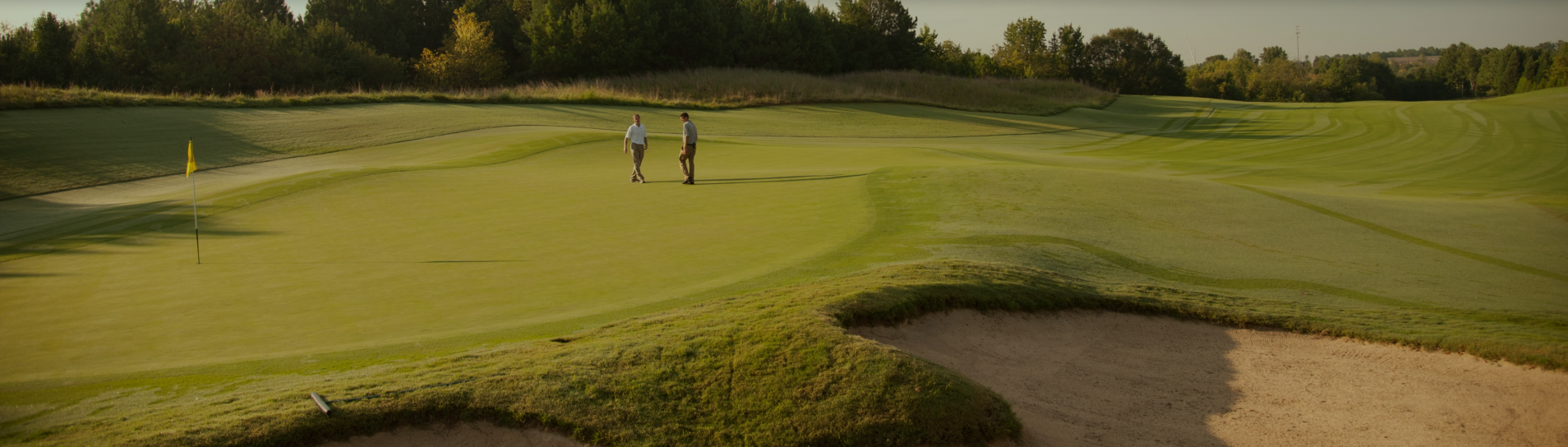
Numerous maintenance-related tasks can be adjusted to save money, become more efficiently completed and go “truly green” at the same time. At Wild Ridge & Mill Run Golf Courses in Eau Claire, Wis., superintendent David Longville has proposed to his board of directors that the courses take significant portions of maintained rough areas and convert them to naturalized areas. Photos by David Longville

With rising prices of fuel, chemicals, fertilizers and labor and a need to keep our green fees and membership pricing competitive with our neighbors, we find ourselves in quite a difficult position.

We are in a time where the economy is struggling, the supply of golf courses exceeds the demand and superintendents are being asked to trim budgets. The need to consider all available maintenance options has never been greater. It’s one thing to be asked to cut the maintenance budget, it’s another to be expected to improve daily conditions at the same time.

With the current trend of “going green,” there couldn’t be a better time to make adjustments in maintaining golf courses and landscapes. We’ve heard a great deal about sustainability, and I’m sure many of you are practicing some of these principles today.

Perhaps we need to do a little better than “go green.” The time may be upon us to “go brown.”

Partially brown

In essence, I’m describing a method of maintenance where we become less green by periodically accepting slightly less-than-perfect conditions. We can accomplish this by using less fertilizer, chemicals, water and labor. By going “partially brown” we can go “truly green” at the same time.

The only way we can do this is if we all come together in a unified effort and share this direction as professional turf managers. One way we can trim budgets and keep our pricing flat is to champion sustainable golf course maintenance practices. There are numerous maintenance-related tasks we can adjust to save money, become more efficient and go “truly green” at the same time (see “Controlling cost with PGRs”).

We spend a great deal of time and money maintaining the roughs and contoured areas around the greens, tees and bunkers. Is all of this really necessary?

I’m proposing to my board of directors that we convert a significant portion of our maintained rough areas to naturalized areas. Also, we’ve all grown to admire those beautiful striping patterns of contour mowing. But we must ask ourselves if this is affordable, if it affects playability, and if, in the end, it’s all necessary?

Do we need to rake all of the bunkers every day? We all love flowers, but what about converting at least some of those annual beds to perennial landscape areas?

Even a task as simple as cup changing costs money. Is it really necessary to change the location of the pin on every hole every day of the week?

Superintendent David Longville at his course this winter. “In our business, we keep fighting to give the same perfect conditions day in and day out and then throw in the discounts and budget cuts on top of that,” he says. “It is an illogical approach, one that cannot sustain itself.” Photo by Doug Hobbs

Something has to give

As long as we’re forced to lower our green fees we will be asked as well to trim our budgets.

We all understand that the course must be in great shape every day or we may not get return business and/or keep our jobs. That is why this notion of becoming more sustainable must be a unified effort. It’s become fairly obvious that we will continue to struggle to stay in business with our current ways of thinking. How can we continue to lower our prices, give daily pristine conditions and pay twice as much for fuel, fertilizer and chemicals? Add to that a water shortage and increases in the minimum wages to our employees. Something has to give.

Look at the hotel industry. For years hotels have been asking us to reuse our linens. The retail food business asks us to bag our own groceries and in some cases actually ring up our own sales. We get the same size bag of chips but with fewer chips in the bag. Laundry detergent is being sold in smaller containers that apparently have a higher concentration of the cleaning agent.

It’s ironic that with all of these changes, the price for these products still has gone up. We keep fighting to give the same perfect conditions day in and day out, then throw in discounts and budget cuts on top of that. It’s an illogical approach, one that cannot sustain itself.

Win, win, win scenario

Wouldn’t it be great if all of us could come together and agree to do no maintenance on our courses once a week? Skipping a day of maintenance at our 36-hole facility would save approximately $1,400 just in labor. Throw in the fuel, equipment maintenance, transportation costs, etc., and we could easily approach a savings of $2,000 on that one day. If this was done the entire growing season we would save $52,000 annually.

According to the National Golf Foundation, there are about 16,000 golf courses in the United States. The calculations above were based on a 36-hole complex. Let’s use an 18-hole example. If only 1 percent of all U.S. courses skipped one day of maintenance per week for 26 weeks, those courses would collectively save $4 million in one year. Twenty-five percent of the courses practicing this method of maintenance would save $104 million.

The positive environmental impacts could be quantifiable if a single course did nothing for one day. If only 1 percent of the total number of U.S. courses got on board, the impact would become increasingly difficult to quantify. If 25 percent of courses did this, it would be hard to imagine the huge positive environmental impact.

Not just money

It is not just about saving money. Doing this would have an enormous positive effect on our environment, our industry and each of us as professional turf managers.

This concept could grow into an Earth Day celebration. We could hoist an Earth Day flag on our flagsticks. This could be the day on which we actually could afford to lower prices without a negative effect on the bottom line.

Our customers would become aware of this day because it would become the national norm. Most of our customers would be enthusiastic about doing something positive for the environment and at the same time getting a reduced green fee. It is a win, win, win scenario.

I realize this proposal would have its challenges. It wouldn’t make sense to skip a day of maintenance only to be forced to do twice as much the following day. Perhaps we don’t need to skip everything, just a few maintenance tasks. The point is that whatever we do, we all need to do it together.

There couldn’t be a better time to take the responsibility and initiative and make changes that could reflect positively on all of us and the industry we have grown to love.

What I’m proposing already is being practiced to some degree in other parts of the world. Most of you have watched the British Open, or perhaps you have visited venues in Europe. What we see is a difference in the level of expectation. We need to change the level of expectation in this country.

Current environmental trends lead me to believe that our customers will embrace this notion, and we could see an increase in our number of rounds. In a time where things have been a little on the down side, that would be a positive
scenario.

I see this as a reasonable approach to decreasing costs, protecting the environment and increasing the number of rounds, all at the same time. We need to do this together, and the time is now.   


Controlling cost with PGRs

For the past five years I have used a system that not only saves my course money, but also fuel, water and wear and tear. The products I name here are simply for full disclosure — I’m not being paid to endorse any of these products.

A demonstration of how plant growth regulators control Poa annua seed heads. The lighter area is where a PGR was not sprayed. “We not only slowed growth and suppressed Poa annua seed heads, but the trials also yielded an overall healthier plant that relies less on chemical, fertilizer
and water inputs,” says
superintendent David Longville.

The first step in this system is to fully utilize plant growth regulators (PGRs). Over the past eight years I have conducted field experiments with different PGRs. We have thoroughly looked at rates, timing and how the grass plants are physically affected. By using these products we not only slowed growth and suppressed Poa annua seed heads, but the trials also yielded an overall healthier plant that relies less on chemical, fertilizer and water inputs.

Many of you are using PGRs regularly on greens. We take the practice of “spoon feeding” and expand it to tees and fairways as well.

This technique has been employed in the cool-season and transition regions, but there’s no reason why it can’t be successfully used with warm-season grasses.

The timing of applications will differ depending on location. We make our first application prior to full bloom of the forsythia. Plant phenology is an accurate method and makes the timing decision easy. We apply 0.0675 ounce of Embark 2S per 1,000 square feet to the putting greens as the forsythia is about to bloom.

It’s necessary to make three consecutive applications spaced 17 days apart. We tank-mix a water-soluble fertilizer with Embark 2S at 0.175 pound of actual nitrogen per 1,000 square feet.

Once the three applications are completed, we lower the rate of the Embark 2S to 0.0475 ounce per 1,000 square feet for Poa annua/bentgrass greens and to 0.035 for the L-93 bentgrass greens. We combine Embark with Primo at 0.175 ounce per 1,000 square feet along with a water-soluble fertilizer at 0.175 pound of nitrogen per 1,000 square feet and other needed and compatible plant protectants. We complete this application at two-week intervals during the growing season.

This program has provided outstanding seed head suppression without sacrificing significant color changes to the grass plants. Be sure to coordinate any spring aerification or other cultural practices around the Embark application; it can slow the healing process in the spring.

Embark 2S suppresses growth and seed head development. This combination appears to slow down the internal clock of the grass plant, thus yielding more stored energy and greater water conservation within the plant.

Three consecutive applications begin for both the tees and fairways at or around the time forsythia is in bloom. For tees and fairways, we use the Embark 2S at 0.10 ounce per 1,000 square feet every 17 days for three consecutive applications. We use a water-soluble fertilizer with Embark 2S at 0.15-0.185 pound of actual nitrogen per 1,000 square feet.

Following the series of three applications, we incorporate Primo into the program at 0.175 ounce per 1,000 square feet mixed with Embark 2S at 0.05 ounce per 1,000 square feet. We do this every three weeks for the remainder of the growing season. We also mix water-soluble fertilizer with the two products at 0.185 pound of actual nitrogen per 1,000 square feet, as well as any needed compatible plant protectants.

We use the Embark/Primo mixture because it’s been found through many years of field research that Poa annua flowers to some degree at just about any time during the growing season. Embark 2S takes care of those seed heads.

Seed head suppression itself has short- and long-term benefits. Over the years of using this program we’ve identified numerous other cost-saving and eco-friendly attributes.

During the past five years we studied this program in two different scenarios. One of the 18-hole courses is predominantly Poa/bentgrass greens with Kentucky bluegrass/Poa/bentgrass tees and fairways. The other 18-hole course is made up of newer L-93 greens and Providence bentgrass tees and fairways. With this program we’ve been able to cut back the three-days-a-week mowing of the tees and fairways at both courses to twice per week.

To break it down further, that’s approximately 55 acres of turf per week during the entire growing season that’s not mowed. In labor alone, we save approximately $8,000. Figure in the fuel savings, equipment maintenance and wear and tear on the equipment, and savings reach $12,000 per year.

There are numerous benefits from a purely agronomic perspective as well. We’ve found less wear and tear on the turf, especially compaction on the cleanup passes. Superintendents often are forced to mow after rain because the turf will be too long at the next scheduled mowing. This program offers much more flexibility. During our trials we’ve actually skipped a mowing because of rain, which means the fairways actually went three days without a mowing. There are few clipping-management issues.

The program’s environmental benefits include lower air and noise pollution as well as decreasing fossil fuel consumption. Another benefit is water usage. The Embark 2S applications decrease the amount of water the plant needs. By using this program over the past five years we’ve cut our fertilizer rates in half and have observed no negative effect on the turf.

We also haven’t applied a pythium fungicide on the tees and fairways in two years. We’ve also seen the occurrence and severity of dollar spot greatly reduced. The grass plants are more evenly fed throughout the entire growing season. This system doesn’t allow for large spikes in the growing cycle via the PGR and spoon feeding protocol. This keeps the plant stronger and more able to ward off disease.

The explanations for the disease resistance observations are similar to the water conservation findings. The plant is storing energy instead of expending it. In keeping the grass plants consistently fed and cutting down on wasting valuable energy for seed head production and growth spurts, the plant can store this energy and call upon it when needed.

— David Longville, CGCS


Leo Feser Award candidate

This article is eligible for the 2009 Leo Feser Award, presented annually since 1977 to the author of the best superintendent-written article published in GCM during the previous year. Superintendents receive a $300 stipend for articles. Feser Award winners receive an all-expenses-paid trip to the Golf Industry Show, where they are recognized. They also have their names engraved on a plaque permanently displayed at GCSAA headquarters.


David Longville, CGCS, is the superintendent of the 36-hole Wild Ridge & Mill Run Golf Courses in Eau Claire, Wis., and a 14-year member of GCSAA.