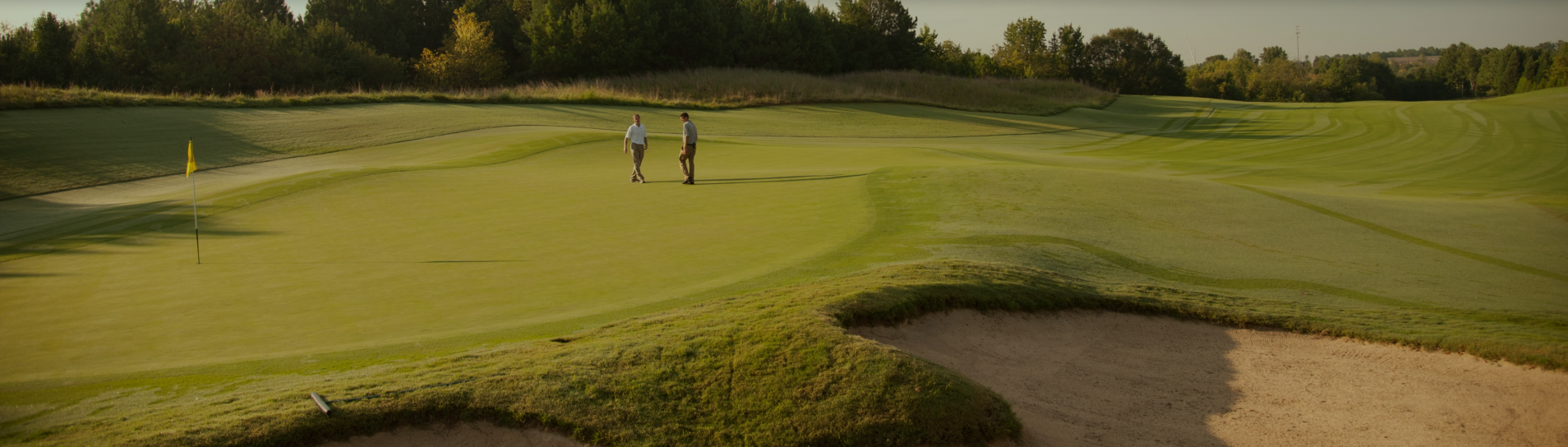
Chris Becker, CGCS, used the
four barns on the property for aesthetics and golfer
protection. |
2000
Leo Feser award candidate |
Many
superintendents dream of owning their own course -- and it is
possible!
Creating a short course can allow a superintendent to keep
his/her present job during and after construction.
Family
and friends can make the best investors.
It
offers an opportunity to own a business in which the entire
family can be involved. |
Pick
any successful golf course construction project and behind it
you'll find a golf course superintendent. We are the focal point
-- part architect, agronomist, builder, accountant -- but rarely
owner.
I have spoken with many
superintendents from many places over the past 25 years, and
without a doubt the No. 1 dream of all those superintendents
(including me) has been to own a golf course. For at least 15
years, that dream has been my part-time job, with hundreds of
hours spent pursuing properties, only to have each one diminish as
the project got closer to reality.
Then one day I woke up and asked
myself, "Why does it have to be championship? Why not
something within my control, using my knowledge and financial
means?"
I began my research on par-3 pitch
and putts. Some very good numbers kept coming up, as did articles
on the necessity of such facilities for beginners and juniors.
These courses generally cost less to build and operate and require
minimum acreage. With my knowledge as a golf course
superintendent, I knew I could build it while I kept my current
job as a superintendent on an 18-hole course 10 miles away.
So my process began. It was
roughly broken into four steps:
 |
Find the property and secure
it. |
 |
Get investment money lined
up. |
 |
Secure finalization of
project. |
 |
Build it, grow it, open it,
manage it. |
Step four is the step that
absolutely stalls, breaks down, roadblocks or just plain
astonishes people pursuing golf course projects. But with a
nine-hole course, it's likely you will be the person to get this
step done. This alone will give you equity and the respect of all
people involved in the project. Even if you can't do the entire
project yourself, the money you'll save with your knowledge and
contacts is overwhelming -- even to a skeptical banker.
For step two, potential investors
include family, friends, local golfers, the current landowner and
other businesspeople. I gave first shot to family, with no need to
go any farther. I was able to maintain 45 percent investment, and
the other 55 percent went to family. With a small Small Business
Administration loan for the group, we were beginning construction
as the ink dried.
A local golf course architect did
the finalization of the plans for presentation to local
authorities and the construction contractor who did the heavy
earth moving and shaping. The rest was all our sweet sweat equity.
Find property
and secure it
Don't get into too big of a
rush. You need several key ingredients: location, road access,
proper zoning, the ability to channel water availability, and of
course, workable ground. Depending on certain factors, such as
trees, buildings and natural terrain, you'll be looking for 7-25
acres.
Becker
says it was difficult at times to get his investors to envision
the completed course. During the early construction phase, he
answered plenty of questions about grow-in and maintenance. He
says his knowledge and experience as a superintendent proved
invaluable. Shown here is the No. 7 hole during construction.
 |
Latah Short Course was built on 6
acres (with no driving range), utilizing the four barns on the
property for aesthetics and golfer protection. We also used trees
and shrub fences. The holes range from 60 yards to 113 yards. It
has grass tees and approximately 2,500 square feet of greens. A
small lake and creek were added for a "big golf course"
feel. A two-story, 1,500-square-foot clubhouse (built to look like
a barn) and parking for 28 cars complete a fun and safe golf
experience that only takes 45 minutes. We are currently
negotiating with the adjacent landowner to purchase 10 acres of
land to add a driving range.
Securing the property is quite
simple. Like buying a house, you negotiate a price and set up
terms. A lot of landowners will carry the contract (especially if
an improvement such as a golf course is going to be built) or
perhaps exchange the land for part ownership in the golf facility.
You'll need to put down earnest money -- $1,000 or so -- while you
ask for 90 days to investigate permits, zoning, bylaws,
preliminary hearings, etc. to make sure the land qualifies for
your project.
Also, don't be bashful about
visiting the neighbors to gather their support. You of all people
can convince them that golf courses are good for our environment.
After
years of working toward his dream of owning his own golf course,
Chris Becker, CGCS, decided to focus his efforts on creating a
short course. His dream has been realized with Latah Short Course
in Spokane, Wash., which attracts beginning golfers of all ages.
The clubhouse, designed like a barn, sits in the background.
|
Get investment
money
Perhaps you are in a different
position than I was and have your own cash flow. However, most of
us will need investors. The landowner will be your first prospect,
then family and others. These prospects will most likely generate
all the money needed for the project.
You'll also want a proper
feasibility study done, which you can do yourself. I recommend
taking the GCSAA educational seminar "The Challenge of Owning
a Golf Course." (Editor's note: This seminar will be
offered Monday, Feb. 14 at GCSAA's conference and show in New
Orleans.)
Most bankers are very receptive to
golf course money requests, but they still have stable "business"
investment requirements. A well-done proforma showing sweat equity
by you and possibly your other investors will keep actual cash
dollars required to start at a much lower and acceptable average
income level. Latah Short Course was financed with a loan of about
40 percent of the value of the project and cash input by the group
of about 20 percent. A sweat equity value of 40 percent was
realized.
Finalize the
project
This step basically involves
tying up all the loose strings, including:
 |
Forming a company type for
your investing group |
 |
Finalizing ownership
percentages |
 |
Securing a loan |
 |
Purchasing land |
 |
Obtaining construction
permits and final architectural drawings |
 |
Developing written agreements
with contractors |
 |
Setting proposed construction
timelines and an opening date |
Build it, grow
it, open it, manage it
Getting my investors to
envision the project was a difficult task. I used ladders to show
elevated tee views, sprayed scrub grass with green dyes to show
where the greens would be and hit golf shots with these potential
investors. Still I got blank looks with the question, "This
will become that?"
Yes, I assured them, and I am the
person who can do it, and do it right for us. The security and
confidence I had in myself, as an investing partner with the
ability to control the transformation, was for us the magic part
that would catapult us as a group to becoming golf course owners.
The
No. 9 hole illustrates the extensive sweat equity put into the
project by Becker and his investors. Becker says he's learned many
things and he's a better superintendent because he must also view
the facility with owner's eyes.
 |
"But what if it doesn't grow?"
they asked. "What kind of grass will we have? Will the greens
be like other courses?" These are just more examples of the
true anxieties of non-turf professionals. I won't go on; you know
the answers to grow-in questions. But remember, you have years of
experience and education in the turfgrass field, so don't take for
granted the wealth of knowledge that brings.
Opening Latah
Short Course
From the first mowing to
opening day were weeks of undeniable excitement for our entire
group. Television, radio, newspapers and local business journals
all hyped the new course in town. The short course was seeded in
mid-September 1997 and opened in early June of 1998
Managing the facility at Latah is
broken into two categories: golf course maintenance (my end); and
the clubhouse, record keeping, payroll, etc. (the responsibility
of the investing partners). We have weekly meetings, monthly group
meetings and yearly company meetings. We chose this method because
it allows us to hire help while still managing the facility
ourselves and maintaining current jobs. Later we will look at
moving into positions ourselves or hiring for the positions. All
areas are operated just like they are at regulation courses --
with budgets, reports, legal issues, etc., to keep abreast with
the investing group's need-to-know information.
Now don't think, "Yeah, but
this guy is some business major, land baron, entrepreneur."
I'm not. Chris Becker, CGCS, that's me! We, as superintendents,
are the key to successful golf courses. We take million-dollar
projects to successful openings, so why not for ourselves? Because
most of us don't have a million dollars! We have jobs that demand
many hours of dedication, and we have families with whom we try to
spend precious time. This balancing act can be thrown out of sync
just trying to put together a major development, let alone carry
it out. A short course truly can be a family affair -- building it
and working it.
I have learned many new things
about golf course management. And I am most definitely a better
superintendent from having the opportunity to see dollars and
expectations through an owner's eyes.
Update
Latah Short Course has been in
operation for 14 months now and continues to show profit. Though
weather in June resulted in a loss, overall there has been
approximately a 20 to 25 percent increase in revenues from one
year ago, with a high repeat-customer rate.
Our original projections of the
ratio of juniors and beginning adults was fairly close; however, a
steady growth of adult beginners has proved that these players
enjoy starting on a short course.
Pace of play has been acceptable,
and there hasn't been any need for course marshaling to maintain
pace. But the overall high percentage of beginning golfers takes
its toll on the golf course -- divots and ball marks being of the
most concern. Free clinics to teach course etiquette and
management have helped, although golfers seems to retain the
information better when they are approached on the course for
direct discussions and hands-on learning.
The lack of a driving range has
not had an impact on the number of people who come out and play
the short course. This may be because golfers don't need to hit
balls or warm up for the necessary swing of a short course.
However, it is a necessary tool to be able to complete the "full
course" offering for lessons and club purchases, especially
woods. Also, as we deal with beginners, a familiar facility such
as our short course would be an attractive site to go hit balls,
adding to revenue.
Becker
and his wife, Suzie, stand on their course with their home in the
background. Becker says the enjoyment of working on his own course
cannot be matched by any job he's ever had.
 |
The workload has been more than I
projected. With two full-time employees working, I still must put
in up to 20 hours per week, mostly on scheduling and equipment
upkeep (greasing, reel to bed knife, etc.) and meetings. Hiring an
employee with a mechanical background and paying more will result
in less of my time (even with new equipment).
Latah Short Course was built
directly across the highway from an 18-hole public course. There
is no competition for golfers. That facility recommends us to
those who should not yet be playing on a regulation course, and we
"grow 'em" and send them back for years of business.
The enjoyment of working on my own
course cannot be matched by any job I have ever had. And beginning
golfers seem to enjoy the golf experience a lot more than advanced
players do. It has been an absolute joy to work with children,
women and seniors as they grow into the game of golf. The
early-stage advancements can be incredible, with only one
drawback: They move on, ready to play regulation courses. The game
of golf is strong, though, and more arrive daily to take on the
challenges of this great game.
Chris Becker, a 23-year GCSAA
member, is the owner of Latah Short Course in Spokane, Wash. He is
also superintendent at Fairways Golf Course in Spokane and has
been there 12 years. |