Superintendent
Matt Sapochak's professional aspirations all came together
when he was asked to oversee design and construction of nine
new holes at Winyah Bay GC. |
2001
Leo Feser award candidate |
Superintendent
Matt Sapochak is making his mark in golf course design. As general
manager at Winyah Bay Golf Club in Georgetown, S.C., the 16-year
GCSAA member has used his creative mind, keen eye toward
maintainability and a tempering view of the big picture to yield a
gem like no other in the area. It offers incredible vistas of
picturesque Winyah Bay on 11 of the 18 holes. Beyond the beautiful
setting is a solid layout that is relatively low maintenance.
Working with limited acreage, Sapochak created a 6,100-yard
masterpiece that is enjoyable for all levels of play.
He came to Winyah Bay in 1998
after being approached by Winyah Bay owner George Marlowe to not
only manage the course, but to redesign the existing nine holes,
design the second nine and do all of the construction in-house.
This opportunity was something Sapochak has dreamed about since
the beginning of his golf course career. Winyah Bay, however, is
only one piece of a fine career that is still very much in the
developmental stage. Sapochak is, after all, only 36.
The early
years
A Pennsylvania native,
Sapochak began his career after graduating from Horry-Georgetown
(S.C.) Technical College with a turf management degree in 1984.
Soon after college, he accepted
the assistant superintendent's position at The Country Club of
South Carolina in Florence, S.C., and got his first taste of
personnel management. He also learned the finer points of how to
successfully manage bentgrass greens in the South.
A year later Sapochak left to find
new challenges, and they came as an assistant superintendent for
North Inlet Corp.'s De Bordieu Country Club in Georgetown, S.C.,
which was still in its early stages. The course was to be
co-designed by the father and son team of Pete and P.B. Dye, who
would have huge impacts on Sapochak's career.
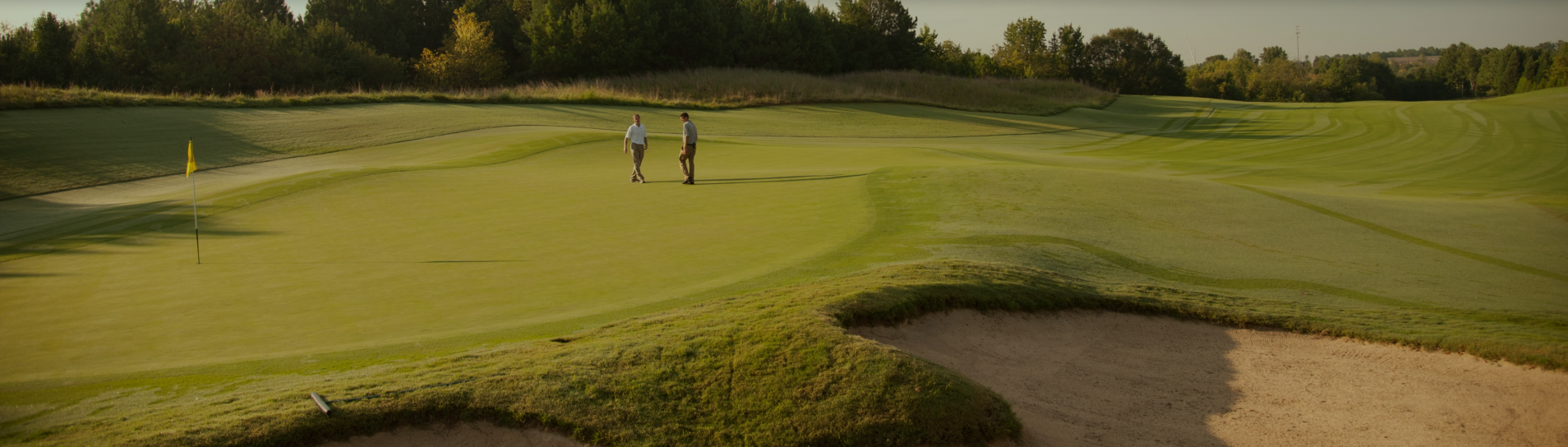
The
new No. 15 at Winyah Bay GC, deisgned, constructed and maintained
by Matt Sapochak.
 |
Since Sapochak started at the very
beginning of the construction project, his first assignment was
refueling bulldozers and excavators from a 55-gallon drum. After a
bulldozer operator became ill, Sapochak got the nod to fill the
vacant bulldozer seat. His duties included cutting roads through
the forest and clearing the centerlines of the future golf holes,
which was quite a hairy task in the thick underbrush of a coastal
Carolina forest. Sapochak knew he was given a great opportunity,
because operating a bulldozer was a lot more appealing than
fueling the equipment. It was not long after that he met P.B. Dye
for the first time.
Lessons from
P.B. Dye
Sapochak's bulldozer operating
skills progressed very quickly, and they did not go unnoticed by
P.B. Dye, who decided to let him try his hand at shaping.
Sapochak remembers, "P.B.
asked me where I was from, and I told him north-central
Pennsylvania. He then asked me to envision the mountains and
valleys of Pennsylvania and how their natural drainage worked.
This was what he wanted me to work toward when I was shaping a
hole."
Sapochak spent many days with P.B
Dye, traveling from one end of the project to the other in Dye's
rental cars. It was not at all unusual to load shovels and rakes
into the trunk of a fully equipped Lincoln Continental or to ride
around the course in a brand-new Camaro with a rod and instrument
sticking out of the open hatchback.
Sapochak credits P.B. Dye with
giving him a lot of freedom in his shaping; however, P.B. Dye
would give it to him straight when he critiqued his work -- good
or bad. When Sapochak reflects on his tenure spent building and
growing in De Bordieu, he says he realizes how fruitful the
experience really was. He had a hand in shaping 12 of the 18
holes, laid out some of the irrigation system and assisted in the
installation of approximately 170 truckloads of Centipede sod.
In July 1987, Sapochak received a
phone call from P.B. Dye, who needed a construction superintendent
at another new course he was co-designing with his father in
Myrtle Beach, S.C., called Prestwick Country Club. Sapochak did
not hesitate to accept the position. Not only would he be the
Dyes' representative, but he would also be staying on after
construction as the course superintendent.
As is his custom with the
construction superintendent, P.B. Dye let Sapochak design one
hole. Although Sapochak did get to do a little shaping, his
responsibility was much more supervisory. He was in charge of
overseeing all construction, laying out lake lines and marking all
areas to be sodded. He also spent a great deal of time with P.B.
Dye laying out the holes while learning more about the philosophy
behind the Dyes' design methods.
After
serving as an assistant during the grow-in of De Bordieu CC in
1985, Sapochak returned in 1989 as head superintendent and stayed
for four more years.
 |
They always took great pride in
their golf courses being built by golfers, and it seems that
almost everyone on their design team was an avid golfer. Sapochak
says P.B. Dye liked to hit golf balls on the project during
construction to aid in the design process. They would literally go
out in the woods and start hitting shots. Many holes were designed
in this manner. Sapochak has carried this technique into his own
recent design work. He also continues to use the Dye philosophy to
design courses that are enjoyable for all golfers, no matter their
level of ability.
Hurricane at
De Bordieu
In July 1989, Sapochak
returned to North Inlet Corp. and De Bordieu CC, but this time as
head superintendent. The position was initially just the
superintendent's responsibilities, but was promised to grow to
include three more new course developments, two to be adjacent to
De Bordieu and one ocean course. The ocean course was also to
include a five-star hotel. This was the type of position that even
the most seasoned superintendents dream of, yet Sapochak was just
25.
Sapochak was barely into his new
position when his dream turned into a nightmare. On Sept. 21,
1989, Hurricane Hugo blew into town. The category IV hurricane hit
De Bordieu CC with 140-mph winds. The course lost 2,500 trees, but
wind damage was minor compared to the storm surge. Many holes were
totally flooded by seawater. All but six greens were flooded with
a deadly blend of sand, mud and saltwater.
After the storm passed, Sapochak
began assessing the damage and the arduous cleanup. Many large
virgin pine trees had to be cleared just so the crew could move
around and assess the damage. Several of the massive pines were
uprooted, taking substantial chunks of earth and, in some
instances, large sections of irrigation pipe with them.
Residential debris, including large household appliances, was
strewn all over the course, and marsh grass completely covered the
course like freshly cut hay in a farmer's field. The storm surge
was so powerful that it peeled up the asphalt in the parking lot
and spread it all over the course. The surge also wreaked havoc on
the course's drainage system.
Even though debris cleanup and
tree removal proved to be monumental tasks, it was the recovery of
the greens that presented the greatest challenge to the young
superintendent. The greens were damaged beyond recovery, and
approval to rebuild them was granted. The greens were reseeded
with Penncross Nov. 1, and the course was finally able to re-open
three months later.
A
chance encounter with Pete and P.B. Dye in 1985 helped Matt
Sapochak develop his design philosophy. From left Sapochak, P.B.
Dye and Pete Dye look over the blueprints for Prestwick CC.
 |
Although Sapochak and his course
had been able to weather the storm, the developer was not. The
developer's financial backing was caught in the savings and loan
collapse; they could not refinance, and resolution trust took
over. All of the future development plans that had brought
Sapochak on board were dashed. However, he stayed at De Bordieu
for four more years.
Moving on
Sapochak's next stop was Deer
Track Golf Resort in Surfside Beach, S.C., a 36-hole resort course
with old bentgrass greens. Sapochak took this position for a
number of reasons. First, he wanted to learn the operations of a
public golf facility. Second, with many more area courses opening
each year, he felt he could learn what it takes to keep a course
competitive. Finally, the course operator wanted to give both
courses a facelift.
It took Sapochak a little while to
become acclimated to the high number of rounds at Deer Track.
However, once the renovation project began, he felt right at home.
The project included changing the contaminated Penncross bentgrass
greens to 328 Tifgreen bermudagrass on the South Course and
Tifdwarf bermudagrass on the North Course, bunker renovation and
irrigation system improvements.
The course facelift also included
drainage renovation and the installation of new golf car paths.
Once the renovation was complete Sapochak found himself with a
much-improved golf course that was better able to withstand the
heavy golfer traffic. He was then able to settle in and learn all
of the nuances of maintaining a high-play resort course.
Putting it all
together
At the beginning of 1998,
Sapochak got the opportunity to utilize all his skills in one
place when Marlowe asked him to come to Winyah Bay GC. Because of
his prior experience in golf construction, golf maintenance and
resort golf, he was able to foresee potential construction
problems, difficult or costly maintenance situations and items
that would affect the marketability of the course. This blend of
experience combined to create a course with very reasonable
construction costs, which would be easy to maintain and, finally,
be enjoyable for golfers of all ages and abilities.
Now Sapochak is in a unique
position as general manager of a course he designed and built. In
addition, Sapochak has had the opportunity to work with his
brother, Hans, a six-year GCSAA member who came on during Winyah
Bay's construction and is currently course superintendent. So far
the golfers' feedback has been overwhelmingly positive. Sapochak,
who is not one to stay stationary for long, says he is always
looking forward to his next design opportunity.
Paul L. Kaufman Jr. is
superintendent at Prestwick Country Club in Myrtle Beach, S.C.,
and a five-year GCSAA member. |