Making the switch

Paul L. Kaufman Jr.

Island Green GC

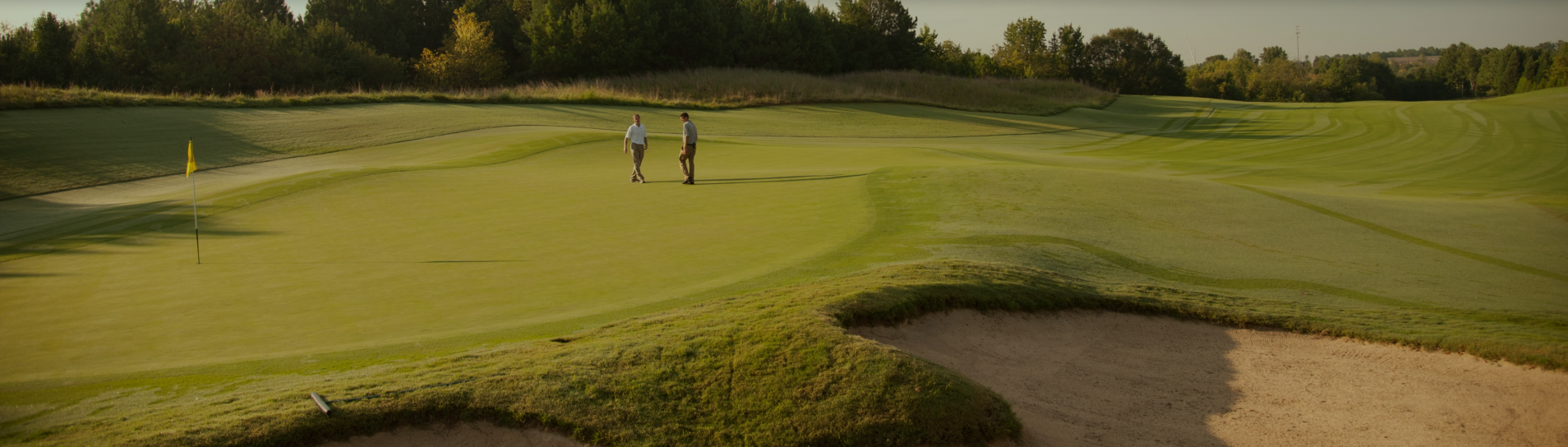
Island Green GC in Myrtle Beach, S.C., underwent a two-year conversion from bermudagrass to bentgrass greens.

Related Articles

2000 Leo Fester Award candidate

A Myrtle Beach superintendent tells how, with limited resources and a two-year plan, he converted to bentgrass by interseeding. When golfers have enjoyed a regular diet of nice bentgrass greens, sometimes even the best bermudagrass greens may be a bit hard to swallow. That was the case for our course in South Carolina.

The majority of golf in Myrtle Beach is played in the nine months from September through May, with northern golfers traveling south when their home courses close. Many of these golfers have been playing on bentgrass all summer. If they plan trips in late September or early October, they're likely to find bermudagrass greens in various stages of overseeding and probably not rolling very well. Meanwhile, bentgrass greens here are thriving as the nighttime temperatures fall.

By the end of May it's a wait-and-see game for those with bermudagrass greens -- wait and see if you have any bermudagrass still alive after it has been overseeded and trampled while dormant. If you have bentgrass greens and you've treated them right throughout the growing season, all you have to do is keep what you have until September.

Of course, I don't take management of bentgrass lightly. But even this far south, you really only have three strong growing months for bermudagrass and nine-plus months that bentgrass can thrive. In my opinion, the bermudagrass cycle is a vicious one.

Getting started at a new club
I started at Island Green Golf Club Jan. 1, 1995. I took the job sight unseen because I was ready to begin my journey as a superintendent. When I was hired, I knew I was in for a renovation project. The first issues that needed to be addressed were drainage and improvement of the turfgrass on the greens. All the greens were basically push-up, with a minimal amount of drainage. The 27-hole course has a total maintenance budget of $450,000 and 180,000 square feet of greens.

This photo, taken in early 1995, shows the thin 328 bermudagrass putting green. The trees in the background created a shade and air-movement problem.
post bentgrass conversion

We topdressed and seeded Poa trivialis to prepare the putting surfaces for the spring golf season. But weighing heavily on my mind was the amount of Tifgreen 328 bermudagrass that lay dormant on those greens. By the end of June it was obvious we'd have to put a lot of sod on the greens.

We decided to begin by rebuilding the nine greens on our Dogwood Course, which had the poorest greens construction and rests in a low-lying area surrounded by a swamp. We shelled out the greens and used the old root zone to reshape the green surrounds and cap off the tees. The tees were then laser-leveled. We built the greens to USGA recommendations and sprigged them with 328 bermudagrass.

The same putting green is shown in mid-July 1999, spost bentgrass conversion. Trees have also been removed around the green.
bermudagrass

In the fall of 1995 we overseeded all the greens, and in June 1996 we had more transition problems. It took us until August to get decent bermudagrass putting surfaces. We knew we had to try something else. We decided it would be bentgrass.

Prepping the course
We could not have made the conversion to bentgrass in 1995. The majority of the greens suffered from shade problems, and the soil structure needed improvement. Trees that had been small at the time of construction were now huge, forcing us to eventually remove more than 500. This has paid huge dividends -- not only has sunlight penetration increased, but air movement has improved tenfold.

The problems with the soil structure were not as easy to remedy. Fortunately, we were able to rebuild the nine that needed it most, but we still had two nines to address. It was out of the question to rebuild the other two nines. Most of the greens had some drainage and they all were convex, which took care of the surface drainage.

This close-up of the L-93 bentgrass was taken in mid-July 1999.
L-93 bentgrass

We started an aggressive aerification program, alternating between core aerifications using 1¼-inch vertidrain tines and core aerifications using standard 5/8-inch tines. We did a total of four core aerifications per year, supplemented with ¼-inch solid tine aerifications to aid in root-zone gas exchange. We always removed the cores and replaced them with straight sand that conformed to USGA recommendations.

We continued the aerification regimen for three years. We have since been able to return to two core aerifications per year. It took a full year before we made any noticeable headway with the root zone.

From bermuda to bent
The first thing I did when considering the bentgrass conversion was call the people who had developed the new varieties, as well as superintendents who were already working with them. I also requested any published material about the new varieties.

I settled on three cultivars: Crenshaw, G-2 and L-93. We divided our nursery green into three sections and interseeded each variety into its own section of bermudagrass on Aug. 10, 1996. Our first method of seeding involved ½-inch deep verticutting. We went in three directions. I was very impressed when it germinated in three days, but a week later, many of the seedlings were dead. I attributed this to the seedlings being exposed on the surface to the wind and the aggressive 328 choking them out.

Ten days later, we were at our planned two-week seeding window. I was concerned about what we had seen happen to the seedlings on the nursery green. During this time frame we also had a scheduled aerification of all the greens. This turned out to be the pot of gold I would trip over.

The first thing we did was Verticut all the greens in three directions. Next, we core aerified with 1¼-inch Vertidrain tines and topdressed the greens. We only filled the aerification holes to between ½ inch and ¼ inch from the top. Then, to help suppress the 328 bermudagrass, we applied a foliarly absorbed growth regulator. The greens were all drop-seeded with Crenshaw, G-2 and L-93. The rate was ¾ pound per 1000 square feet for each variety.

Again the seed germinated in three days, but this time we had seedlings germinating in the aerification holes. The seedlings in the holes were well protected from drying wind and also from the 328. The bentgrass seedlings still thinned out between the aerifier holes, but in the holes we had bentgrass growing stronger by the day. Ten days after germination we put out a starter fertilizer.

Superintendent Paul Kaufman says during the conversion, he learned quickly just how aggressive the new bentgrass varieties are. After the first summer, he had achieved a 60/40 bent-to-bermuda mix. This shot shows the L-93 in July 1999.
bentgrass varieties

The bermudagrass came right back when the growth regulator wore off, but the bentgrass held strong in the aerification holes. It was as if we had plugged bentgrass into the greens.

Nevertheless, I knew I wouldn't have any mature bentgrass until February 1997. I did have some Poa trivialis on standby for November to ensure a putting surface for the spring golf season, but I wanted to grow the bentgrass plugs as hard as we could before seeding the Poa. We ended up putting out a total of 5 pounds per 1000 square feet of Poa trivialis in late November.

The greens thinned some when the 328 bermudagrass went dormant, but we were able to maintain a respectable putting surface through the end of January 1997. By February the weather was starting to cooperate with warmer temperatures. It seemed that overnight we had mature bentgrass in our aerification holes, and it was spreading.

Communicating the conversion
We had planned another aerification for the beginning of February so we decided to interseed again. At first we couldn't find any available seed. Everyone was sold out of the new varieties, and none would be available until the end of the next summer.

bentgrass varities

Somewhere, somehow, my sales representative, John Patton of ABT-Sunbelt Seeds, came up with a couple hundred pounds of Crenshaw and L-93. We aerified the greens with 5/8-inch hollow tines, topdressed and seeded the greens again. This time we seeded ½ pound per 1000 square feet of both the Crenshaw and the L-93. It germinated in the holes, and we had that many more bentgrass plugs in the greens.

We had a good putting surface for the rest of the spring, although there was a lot of Poa trivialis on the greens. I was asked to speak at the April men's club meeting, and the tone of the meeting was very upbeat. Most comments were positive, and I could tell they were very excited about the greens.

This was quite a morale boost, but I wanted to prepare them for what could be a long summer. A pre-warning of a worst-case scenario can sometimes help. I told them I was pleased with the conversion so far, but it would be at least a two-year process. I also informed them that a lot of what was there was Poa trivialis and that it would not be there forever. I emphasized that the greens could get a little ugly and that our main goal was to hang on to as much mature bentgrass as we could until the end of the summer when we could seed again. This may have let a little wind out of their sails, but it was in everyone's best interests for me to be upfront.

Another year, growing stronger
The first week of June 1997 we aerified the greens with 5/8-inch coring tines. We didn't topdress the greens, but instead left the holes open to breathe. This practice really helps keep the greens from sealing off over the course of the summer. We also applied a 6-ounce/per 1000 square feet Koban root drench, and the open holes let us get the fungicide well down into the root zone. I like to refer to this as my pre-emergent for Pythium. It really makes watering more effective.

Summer was an adventure in walking a thin line. We had to water the greens enough to keep the bentgrass alive, but we also had to transition out the Poa trivialis. I wouldn't feel confident trying to chemically remove the bermudagrass the first year. I believe you would end up with greens that are thin and full of algae.

Furthermore, the new aggressive varieties will hold their own quite well against the bermuda. In fact, in our first year they were outcompeting the bermudagrass. One thing we quickly discovered was how aggressive the new bentgrass varieties really are. I believed strongly that interseeding to convert from bermudagrass to the new bentgrass varieties the first summer would result in "brent" (ber-muda/bentgrass). But we ended the first summer with a 60/40 bentgrass-to-bermudagrass mix, and none of our fears came true.

When August 1997, rolled around, it was time to aerify and interseed again. We used the 1¼-inch Vertidrain tines and the same topdressing procedure. We decided to seed with straight L-93 at ¾ pound per 1000 square feet. We repeated the aerification and interseeding process again at the beginning of October using 5/8-inch coring tines and the same seeding rate.

The conversion team included (from left): James Whitesides, current assistant superintendent at Island Green; Kaufman; Lee Carmichael, former assistant superintendent, now superintendent at Indigo Creek GC; and Dale Morris, summer intern through conversion, now assistant superintendent at Indigo Creek GC.
conversion team

Early in November we made our first of many applications of Tupersan. We used 1 pound Tupersan/1000 square feet to protect our 328 collars. After many Tupersan applications, we found the most effective timing for bermudagrass control is late fall, right before the bermuda is put to bed for the winter. That really hurts the bermudagrass. We did not seed any Poa trivialis onto the greens in 1997. By February 1998, we had a nice stand of bentgrass. We continued with two more aerifications and seed applications: one in February and one in April. In May we applied Tupersan, again at 1 pound Tupersan/1000 square feet.

When summer rolled around, we had a very mature stand of bentgrass, no Poa trivialis and a negligible amount of 328. We were starting to see the light at the end of the tunnel. We made another application of Tupersan ½ pound per 1000 square feet in August when the 328 started to poke through. The bermudagrass was actively growing and the chemical really only suppressed it, but that was enough to keep the bentgrass in charge. By the end of August 1998, our ratio of bentgrass/bermudagrass was 85/15 -- not bad after two years. The best part was how strong the new bentgrass varieties were at the end of the summer. We still had more than 3 inches of roots consistently from green to green.

John Sally, owner of Carolina Turf Partners Inc. (left) and Kaufman take an undisturbed soil sample for ISTRC Labs.
soil sample

During the first year, $5,000 was spent on seed (3 pounds per/1,000 sq. feet at $10 a pound) and about half that amount was spent on seed the second year. About $1,000 will have to be spent on seed in following years.

Soil improvement
In September 1998 it was obvious we had made major headway improving our soil structure, so we took some undisturbed cores for soil tests. Undisturbed sampling takes a core from a green and keeps it intact throughout the sampling process. The core was sent to International Sports Turf Research Center Labs, which conducts a complete physical analysis of the root zone.

While the sample is drying, time-lapse photographs are taken at different stages of the process. These pictures reveal the most subtle layers, which would not be visible any other way. Once the sample is dried, it's broken out, and textural/particle size and organic content analyses are conducted on each inch of the sample.

After the testing is done, the staff member doing the report calls the superintendent to get a background of the green from which the particular core was taken. The lab needs to know about the surrounding micro-environment, the green's size, the initial construction method and how much play the green receives.

The final stage of the service is a report complete with the soil's physical properties (including infiltration rate, porosity and bulk density with organic and particle distribution by layer), the dry-down pictures and in-depth recommendations of what needs to be addressed and at what depth.

From this sampling procedure, we've been able to benchmark a couple of our greens from year to year. We were actually able to watch our greens' progress. Because of this, we decided at summer's end 1998 that we could modify our cultural practices to fit our improved greens. I no longer believed it necessary to use such large coring tines or to topdress so heavily.

Our September aerification is now done at the end of the month, and we only use ½-inch coring tines. We still put out ½ pound per 1000 square feet of L-93 seed, but I don't think it would have made a difference if we had not seeded.

We also changed our topdressing program significantly. Instead of heavy, infrequent topdressing, we started topdressing lightly every two weeks. This change has really made a difference in golfers' attitudes toward topdressing. With the new schedule, we're able to keep a more consistent putting surface.

In late October 1998 we noticed how tight the greens were getting and that a substantial thatch layer was developing. It was obviously time for an old standby: the Mataway. We put new blades on the machine and set them at ¾ inch deep. All the greens were Verticut in two directions. It was unbelievable how much material was pulled out of the greens. I wasn't completely sure I had made the right decision, but after the greens were cleaned up and rolled, they putted great and were still visually appealing. Within a week you could hardly tell we had Verticut. The new bentgrass varieties are truly a superintendent's dream come true.

When we made the decision to try the conversion, most people thought we were crazy. But a little over two years after we started the process, we achieved success.

I can understand the criticism. We were attempting a conversion to bentgrass using the extremely new method of interseeding; we had poor greens construction; and our budget was quite modest.

I guess I was lucky -- lucky to have several people on my staff who were committed from the beginning. Just like me, they loved the challenge. We took all the pessimistic comments and used them as fuel to get us through the tough times. It's amazing what people with a common goal can achieve.


Paul Kaufman Jr. is superintendent at Island Green Golf Club in Myrtle Beach, S.C., and a four-year GCSAA member.