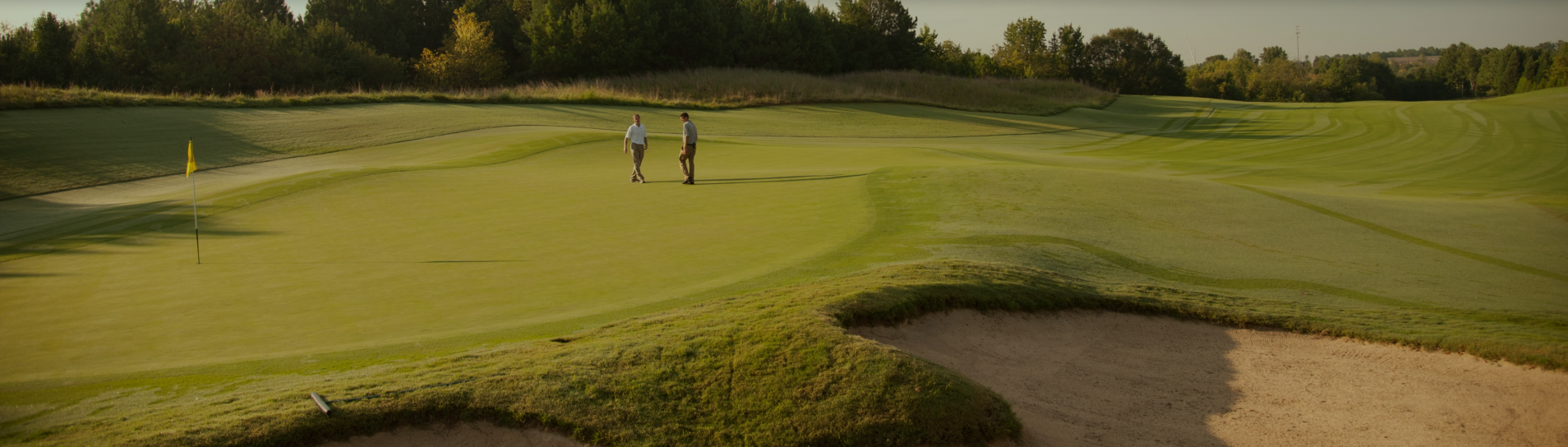
Superintendent Vince Keats
outlines his four-part strategy for successfully managing
native species. |
2000
Leo Feser award candidate |
Using
IPM techniques for native plants helps conserve water and
reduce pesticide use.
Care
of native plants should focus on maintaining the plant
community and the course's playable conditions.
Some
plants may have safety issues, such as causing skin
irritations, so keep this in mind when selecting plants.
Modify
an IPM plan to fit your specific situation.
|
I
have developed an innovative, four-point approach to using
Integrated Pest Management (IPM) on the golf course. It's
innovative because it involves using IPM as a planning tool for
non-turf applications, specifically to manage native plant areas.
Why is it important to use IPM to
manage native plants? Using native plants on the golf course is a
big step toward conserving water and reducing fertilizer and
pesticide use.
As superintendents we are
accustomed to applying IPM techniques on turf. Native plants
generally have different needs and therefore must be managed
differently. This makes IPM a valuable tool for managing native
species.
Discovering
the native option
Native plants can be added to
a golf course at any time: by the design team for a new golf
course, by the superintendent at an established course, or by the
superintendent who needs to renovate existing native areas.
I gained five years' experience
managing native vegetation at The Olympic Club in San Francisco,
where I was assistant superintendent in charge of the Cliffs
Course. The Cliffs, one of three courses at Olympic, is a
nine-hole, par 3 with spectacular views of the Pacific Ocean. What
gives the Cliffs its unusual character is the use of native
coastal vegetation for the roughs.
Using natives for the roughs was a
great choice. The native plants that grow along this portion of
the California coast, like most California natives, are
drought-adapted -- they depend on rainfall for irrigation. The
majority of rain typically occurs from November through March, so
these plants receive no water the rest of the year. These plants
create a rugged-looking plant community that matches the rugged
terrain of the California coastline.
The concept for the Cliffs was to
give it a "links course" character by re-creating sand
dunes and using native coastal vegetation. As the primary
component of the rough, these plants would provide an open, sparse
area so that golfers could easily find their balls and hit them
out. However, the rough grew in thick and lush. In addition, one
of the native species dominated, choking out the other natives in
the mix. As a result, errant shots swallowed up by the rough were
never to be found again.
This situation did not provide
golfers with an enjoyable experience. Something needed to be done.
I realized the only way to gain control of this situation was to
implement an IPM program. My four-point approach was simple:
 |
Define IPM |
 |
Understand the needs of
natives |
 |
Select plants |
 |
Select plant locations |
Defining IPM
Even though IPM is a
well-known concept and practice for most superintendents, it's a
good idea to reinforce this with a working definition. I wanted to
be sure IPM would be appropriate for what I was doing and that my
plan would be in accordance with an IPM program.
During
his tenure at the Cliffs Course at The Olympic Club in San
Fancisco, Vince Keats developed an IPM plan for the native
non-turf flora.
 |
There is a lot of good information
about IPM on the Web. I found this definition of IPM on the EPA
Web site: "Using common-sense practices, environmental
information and available pest-control methods to prevent
unacceptable levels of pest damage, economically and without
harming people, property or the environment."
This is a wonderful definition
because it tells you what to do, yet it gives you the freedom to
determine how best to do it. As long as we follow the definition,
superintendents' IPM programs can be as innovative as necessary to
achieve our desired goals.
Understanding
natives' needs
I will discuss native plants
that are indigenous to the central coast region of California and
that are drought-adapted, as I mentioned previously. The community
as a whole has a very open growth habit -- patches of vegetation
spanned by open, rocky or sandy terrain. In their natural states,
these plants receive only the water and fertilizer Mother Nature
provides. In nature these plants require no maintenance.
Likewise, on the golf course they
do not require supplemental irrigation or fertilizer. They should
only require the maintenance necessary to maintain a native plant
community and playable conditions. Compare that with the needs of
cultivated turfgrass on the course! Our turf requires supplemental
irrigation, regular applications of fertilizer and constant
mowing. Keep in mind that two different plant communities with
different requirements are going to be placed next to each other.
There is potential for conflict.
Using
native plants for natural areas, such as in front of a bunker,
gave the course a rugged look to match the terrain of the rugged
Northern California coastline.
 |
Selecting
plants
So you want to use native
plants -- good choice! But make sure your specific choices are
good. Here are some helpful criteria.
Safety. This is the
biggest concern because some natives, such as poison oak, can
cause severe skin irritation. Other natives, such as blackberries,
have spines. These plants are not safe for human contact and
should obviously be avoided. Keep in mind that if they occur on
the site, you'll have to deal with them as part of regular
maintenance.
Appropriateness. Not all
natives are appropriate, such as those mentioned previously. Still
others may have undesirable growth habits (spreading, very thick
and dense, and/or too upright). Identify the characteristics that
fit your course and then choose accordingly. For the Cliffs
Course, plants were selected using the above criteria and by
inspecting the site and adjacent areas. Five native plant species
were selected for use in the roughs.
Selecting
plant locations
Location is critical. There
are four points you must consider: placement, isolation,
manageability and visibility.
Placement. The
characteristics of native plants are far different than those of
the turf varieties used on the golf course. Natives do not offer a
great playing surface. Placement of natives can become a question
of design when deciding on their function. Will they have
architectural significance? Will they be part of waste areas?
Consider the role they will play on the course and place them
accordingly. We realized that placement of some of the native
areas on the Cliffs was too penal. We scaled them back to create
fair playing conditions.
Isolation. As I mentioned,
keep in mind that two different communities with different
requirements are going to be placed next to each other. There is
potential for conflict, and you must isolate the natives from your
turf maintenance practices. The Cliffs Course features a very
tight and challenging layout. The reason my native areas exploded
with growth is that I let turf maintenance practices spill over
onto the native areas. Whenever the turf was irrigated, so were
the natives. Whenever the turf received fertilizer, so did the
natives. This resulted in an explosion of growth and caused one
species to dominate. Locate native areas so that they can be
easily isolated from your turf maintenance. Adjust sprinklers to
water only the turf and make sure fertilizer can be applied easily
without spreading to the natives.
Keats
stresses the importance of selecting the right plants. On the
Cliffs Course at The Olympic Club, one native plant species grew
in too thick and lush and became a pest by swallowing up errant
shots.
 |
Manageability. Do not
create areas so large that they are difficult to manage. Even if
you have successfully isolated your native areas, they will still
require some management. Unwanted natives will creep in, along
with the usual assortment of exotic weeds. To gain control on the
Cliffs, I focused on areas that adversely affected play. Some
sections could be improved by thinning and adjusting irrigation to
remain on the turf. Some sections were converted to grass to
provide acceptable playing conditions. Though these sections were
just a small portion of the total acreage of natives, working them
had a big impact in gaining control.
Visibility. Part of the
golf experience is enjoying the surroundings. Native plants are an
excellent way to tie the golf course into its surroundings. Locate
native plants so they can be seen. Pick out three or four
locations where they will be showcased. Showcasing on the Cliffs
was easy. You can stand in one spot and see the entire course.
After addressing the playability issue, I found that these
sections were adjacent to key visual areas. By focusing
maintenance on these areas, I finally gained control over the
native roughs.
Starting a
program
Following these four simple
steps can help you avoid many of the problems I encountered. The
beauty of this plan is that you can start using IPM before you
even plant a seed.
Does this plan fit into the
definition of an IPM program? Yes. Common-sense strategies are
being used in the planning process. Environmental knowledge is
essential to understanding the needs of native plants. You will be
taking big steps to control pests economically and without harming
people, property or the environment.
For more information on IPM, visit
www.epa.gov/pesticides/food/ipm.htm.
Use this plan, but modify it to
fit your situation. Maybe it can be useful in other non-turf
applications. It won't take care of all your pest problems, but it
offers a good start for successful management of native areas.
Take it to your course, experiment and be innovative!
Vince Keats is superintendent
at Napa Valley Country Club in Napa Valley, Calif., and a six-year
GCSAA member. He is a former assistant superintendent of the
Cliffs Course at The Olympic Club in San Francisco. He presented
this information at the Innovative Superintendent Sessions at the
GCSAA conference and show in New Orleans. |