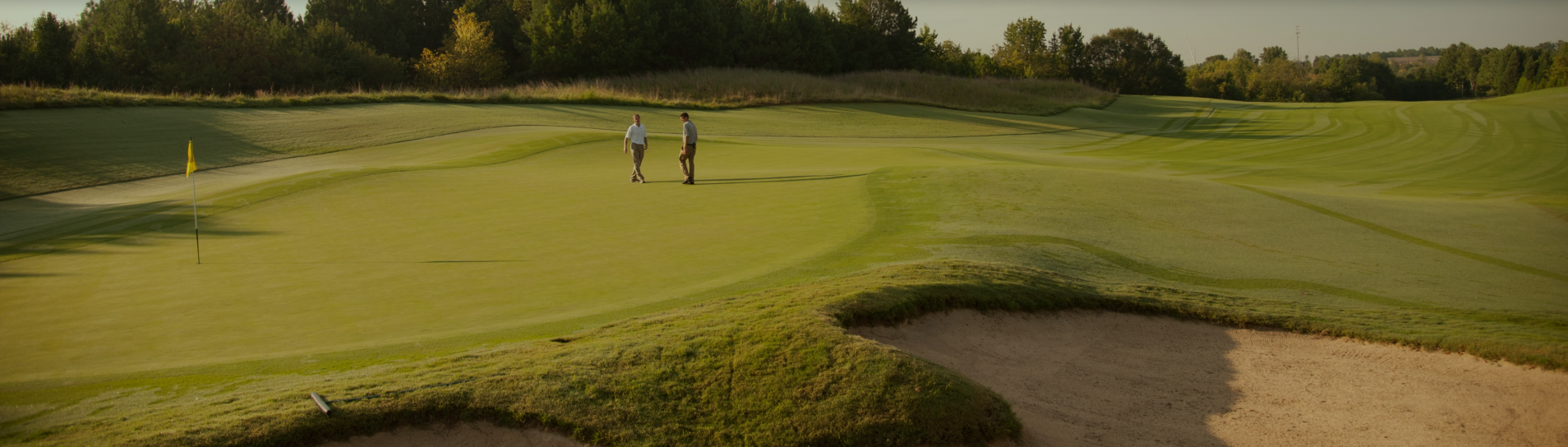
The emergency call box system
at Rockrimmon CC in Stamford, Conn., has boxes located
throughout the facility. This means that AEDs can be brought
to cardiac arrest victims quickly anywhere on the course. |
2001
Leo Feser award candidate |
A
golf course is the fifth most likely place where cardiac
arrests may occur; almost 20 percent of all golf facilities
will have a cardiac emergency; and it's now the No. 1 cause of
death at golf facilities worldwide.
AEDs
are designed so nonmedical personnel with only a little
training can use them effectively.
A
comprehensive safety training program is essential to combat
the natural desire to panic.
It's
important to promote the program aggressively to prevent a
tragedy because patrons are not aware of the facility's
emergency capabilities.
Legal
considerations and possible ramifications should not be a
deterrent to implementing an AED program.
|
Every
day around the world, doctors, scientists, technicians and
researchers are working to find ways to improve our general
health, well-being and life expectancy, as well as to combat and
repair the systemic problems of disease and injury that can affect
us all. With greater and greater success, these professionals find
ways to achieve these goals.
In the area of emergency cardiac
care, a technological breakthrough now enables nonmedical
personnel to save the life of another. That technological
breakthrough is called the Automatic External Defibrillator, or
AED, and it may stand as the one of the greatest emergency safety
measures ever developed in the golf and recreation fields.
The cases of Garland Dempsey and
Jerry Fuents demonstrate the value of this new tool at golf
facilities. Fuents was a spectator at a 1999 PGA event in Texas,
and Dempsey was working inside the ropes as a caddie. Each
suffered a heart attack during the event. Both men received prompt
EMS care, and both men were saved because medics were equipped
with AED units, which restarted their malfunctioning hearts and
helped save their lives.
Over the last two years, I've been
fortunate to observe firsthand the initial implementation of an
AED device at my golf facility, Rockrimmon Country Club in
Stamford, Conn. It is one of the first clubs to develop a safety
and training program centered on this life-saving equipment. In
the course of the programs development, we have really had our
eyes opened to the extreme value of the AED in facility safety.
The facts
The AED is primarily a device
used to assist someone suffering from cardiac arrest. Cardiac
arrest is defined as a sudden cessation (stopping) of one's
heartbeat. In many cases cardiac arrest occurs when the heart has
been, or is in, ventricular fibrillation: a disruption in its
proper muscular rhythm and pulse resulting in a disruption of
blood circulation.
Despite general advances in
medicine and individual health and dietary practices, more than
800 people still die every day from cardiac arrest. That's one
person every 29 seconds and more than 300,000 deaths from cardiac
arrest each year.
If that figure can be swallowed,
then here's one that will be of interest to all those in the golf
business. Statistics have shown that a golf course is now the
fifth most likely place where those 300,000-plus cardiac arrests
may occur. When you consider that hospitals and homes are No. 1
and No. 2, the golf course's No. 5 ranking is surprising indeed.
CGCS
Anthony Girardi (shown with his dog Baron) has made Rockrimmon CC
a safer place for golfers with the introduction of AEDs and a
staff well-trained in their use.
 |
In addition, it's estimated that
almost 20 percent of all golf course facilities will have a
cardiac emergency, and it's now the No. 1 cause of death at golf
facilities worldwide.
Technology to
save lives
In the event of a cardiac
arrest, time is perhaps the most crucial element for a person's
survival. According to cardiologists, for every minute that passes
without defibrillation (the act of restoring normal beating rhythm
to a heart in cardiac arrest), a victim's chances of survival
decrease by 7 to 10 percent. After 10 minutes, very few
resuscitation attempts prove successful.
The AED is a device that provides
defibrillation, via electric current, to restore normal rhythm to
the heart. Although this sounds like a complex process, the
machine is designed so nonmedical personnel with only a little
training can use it effectively. The unit is relatively light,
weighing less than 15 pounds, and has very clear and
self-explanatory controls that, with the support of instructional
training, can be deployed efficiently and, most important of all,
quickly.
There are four basic steps
involved in using the AED, which the machine, through audible
voice prompts, "talks" the user through -- a
revolutionary innovation in and of itself. Once it is brought to
the victim's side, the unit's power must be turned on (it's
battery-charged, thus making it portable) and the "diagnostic"
phase of the machine's capabilities becomes the first priority.
Next is the placement of the
unit's two electric pads that serve as a conduit for both electric
analysis and, later, administration of defibrillation. These pads
are placed on the victim's chest, one under the right armpit and
the other under the general area of the heart. This step serves to
establish the condition of the heart's rhythm and beat.
The most fascinating feature of
the AED is what happens next: The machine automatically assesses
whether or not shock stimulation is necessary in that particular
victim's case. If the assessment is affirmative, the unit then
automatically administers an electric charge to begin
defibrillation. If the assessment is negative, no shock is
applied.
Studies have shown that AED units
are remarkably accurate in making this crucial assessment of a
victim's condition. They make the correct "shock"
decision 90 out of 100 times, and the correct "no shock"
decision 95 out of 100 times. In this regard, the AED unit is
nearly as adept as having a cardiologist administer the victim's
emergency care.
Training
lifesavers
However, for a facility to
make proper and effective use of the technology, while integrating
it with a total health and safety program, it takes more than just
having the AED unit on hand. It cannot be stressed enough that a
comprehensive program is important to the success of the AED in
saving lives.
By their nature, cardiac arrest
situations are ones of great emergency and, sometimes, great
panic. Every facility needs a reliable system of training,
practice and education to combat the natural desire to panic.
A variety of issues need to be
covered: staff training, maintenance and upkeep of the unit,
deployment and emergency access, and communication and promotion.
The most important of these factors is the staff training program.
At Rockrimmon, our approach was to
train personnel in a group format. From the maitre d' to the
receptionist to the starter, the club included an array of
personnel whom management believed it was vital to train in AED
and emergency care administration.
Our initial training session,
sponsored by the AED manufacturer in conjunction with the local
EMS, lasted 3 to 4 hours and was conducted with the supervision of
a certified physician. During the session, which included a review
of basic CPR (cardiopulmonary resuscitation) techniques (CPR
certification is also desired) and a discussion of the signs of
cardiac arrest, the group got a thorough overview of the device
and its usage through lecture, demonstration and hands-on
experience. By the time the session was over, our attendees knew
how to administer AED aid to a victim within 90 seconds of
arriving at his or her side.
Some states require EMS
notification of your AED program, but even if yours does not, it's
a smart idea to link and integrate local EMS in your total
program. They can help provide additional training and periodic
update reviews; they can store your AED locations in their
dispatch database; and they will become familiar with your trained
staff and facility in the event of cardiac arrest (or any other)
emergencies.
Modern
technology has made AEDs smaller and less expensive and thus
available for use in public places such as golf courses. Most
brands have similar features and cost around $3,000.
 |
Keeping your
AED program healthy
Maintaining your AED's
function via inspection -- a critical element of your
defibrillator program -- is easy because of some of the built-in
features found in most brands of AED units. One of these is a
self-test feature that will engage periodically and sound an alarm
if a problem is noted. Another is a maintenance checklist that
makes inspections reliable and standardized no matter which of
your trained staff members is performing it.
The AED unit must be placed in a
central and accessible location. As mentioned previously, time is
the crucial element in a victim's chances of surviving cardiac
arrest. It's the goal of our club to place the unit where it can
be retrieved and brought to the victim within 3 minutes of
receiving a distress call. This would allow for actual aid to be
administered in no more than 4 ½ minutes from the time of
alert.
How does a distant location
distress call reach the staff? At Rockrimmon, this is achieved
through a complete and thorough deployment of a "satellite"
communication system with emergency call boxes located at key
points and central locations throughout the facility. Over the
last decade, many golf courses have set up similar emergency
systems, and these are helpful additions to an AED program.
Call boxes are engaged by pressing
an oversized red button in the center of the box, at which point
the person reporting the emergency can engage in two-way
communication with two "home base" locations. At
Rockrimmon these locations are the clubhouse's front reception
desk and the golf starter's office. But each facility may
determine a different scheme, depending on its physical layout.
With prudent deployment, no area
should be more than moments away from emergency call access.
However, in addition to the "satellite" emergency
communications, our club has regular phone lines that can connect
two club locations and that have dial-out capabilities as well.
These phones have been long stationed at fixed points on our golf
course and are usually used for a variety of pedestrian and
member-convenience reasons. But they also serve as a support to
the emergency "satellite" system and can get aid to a
victim just as quickly.
For the AED unit itself, periodic
maintenance and inspection should be part of your program routine
-- perhaps with reviews at the beginning, middle and end of the
season.
Communicating
the program
None of the training,
deployment strategy or communications setup will matter if people
don't know about your AED program and the support emergency
services that you offer. The worst thing imaginable would be to
have someone die from cardiac arrest because he or she, or others,
did not know that life-saving assistance was only minutes away.
The only way to prevent a tragedy
caused by a lack of knowledge is to promote your program
aggressively throughout your facility. Two time-tested ways are
club/organization mailings, usually at the outset of the golf
season with reminders in subsequent seasons; and in club bulletin
board postings, whether in the front lobby or near the entrances
and exits of locker rooms.
Another valuable resource in
spreading the word is member committees. We have found that
keeping our various governing committees (green, golf, house,
etc.) up to date on the program helps disseminate the facts among
the entire membership.
In addition, we have developed a
small emergency-notice placard that we place in every golf car
that provides information on our entire safety program and
identifies the emergency communication locations.
Liability
concerns
In our increasingly litigious
society, some facilities may be concerned about legal issues and
use of AEDs. Often, increased capability means increased
responsibility, which sometimes brings the fear of increased
liability for facilities enacting an AED program. The main
question in this regard is, "Can I or my facility be, in any
way, held liable for someone's death or injury in properly
administering AED emergency care?"
Thankfully, the answer is no. Most
states have enacted some form of a "good Samaritan" law,
which removes liability from those legally trained to administer a
variety of first-aid measures, AED assistance among them. A
federal law, titled "The Cardiac Arrest Survival Act,"
is pending before Congress. It would further insulate aid
providers from litigation.
To date, no known suits or
compensation claims have been brought against any individual or
organization for emergency aid rendered with an AED unit. In fact,
the growing volume of cases in both civil and criminal law are
indicating that courts would be more likely to hear suits against
those who do not provide safety options such as an AED to the
people who use the facility. Legal considerations and possible
ramifications should not be a deterrent to getting an AED program
installed at your golf facility.
A small price
to pay. . .
Selecting an AED unit is a
fairly straightforward procedure. There are three principal
manufacturers who distribute the unit: HP Heartstream's
Forerunner, Physio-Control's Lifepak and Survivalink's FirstSave.
All three meet FDA guidelines and standards, and all have similar
features. The choice can be based solely on the system you believe
works best for the needs of your facility. Most units cost about
$3,000, a small price to pay for someone's life.
The Automatic External
Defibrillator is a cutting-edge piece of technology that allows
laypersons to save the life of another at a place where statistics
show a high incidence of cardiac arrest. It is an efficient,
accurate and time-tested piece of medical equipment that, when
integrated into a well-developed program, can mean the crucial
difference between life and death.
Anthony Girardi is CGCS at
Rockrimmon CC in Stamford, Conn., and a 10-year GCSAA member. He
presented this information at the Innovative Superintendent
Sessions at the New Orleans conference and show. The American
Heart Association and Golf Digest's Links for Life campaign
provided some of the information in the presentation and article.
GCSAA is a member of the Links for Life coalition.
|