GCM

A family affair

A superintendent and his family transform their Ohio farmland into Sable Creek Golf Course.

Bob Frase

Sable Creek GC

Sable Creek GC, which opened in 1994, was built on the family farmland of superintendent/owner Bob Frase.

Related Articles

{short description of image}2001 Leo Feser award candidate

Building a golf course, even under the best conditions, is a daunting task. Coordinating the many people involved -- excavators, irrigation crews, architects and general contractors -- can become a tremendous challenge. In addition to the actual construction, many complex rules and regulations governing the operation of golf courses need to be mastered. When I began the construction of Sable Creek Golf Course in Hartville, Ohio, in 1993, I faced many of those challenges. However, with the support and assistance of my family, I was able to overcome even the most difficult obstacles.

In the blood
To better understand why I took on the challenge of building my own golf course, you only have to look at my background. I was raised on a small farm in Hartville that my father maintained more as a hobby than a career. Those early days of working on the farm gave me a taste for the simple and rewarding pleasure of watching things grow from the toil of your hands.

This appreciation of outdoor labor led me to my first real job as a member of the maintenance crew at Tannenhauf Golf Course in Alliance, Ohio. I was immediately smitten. I decided to pursue a career in golf course maintenance. After graduating from high school, I went to Penn State University and received a turfgrass management certificate.

Frase is often accompanied at work by his dog, Cheyenne.
Frase and Cheyenne

After graduating from Penn State, I returned to my job at Tannenhauf and shortly thereafter married my high school sweetheart, Mary. We had barely settled in our new apartment before I decided it was time to put my education to use. So I started beating the pavement and landed a superintendent's job at Bob O'Link Golf Course in Canton, Ohio. Mary and I wasted little time in starting to raise a family. Before I could turn around, I had two boys and one on the way. I needed a change. After five years at Bob O' Link, I came upon an excellent superintendent's job at Seven Hills Country Club, a course being built in Hartville.

Working on the construction of Seven Hills kept me busy. Just not busy enough. By my third year there, I had five children running or crawling around my house. It was time for drastic measures. I now had to figure out how to keep a family of seven fed and clothed.

Opportunity knocks
As anyone who has been around golf course maintenance for awhile can attest to, superintendents did not get paid all that well during the 1960s and 1970s. It was during this period that I ventured into side jobs and other businesses to bring home a little extra money. In the mid-'60s I saw a real market for sod, so my brother-in-law and I started a sod farm on my father's land. We did relatively well, but just couldn't seem to keep the business going. Later, I started raising crops. I grew cantaloupes in the back of my house and sweet corn at my father's farm. I am sure that neither my wife nor my kids look back on those days with any fondness. In the morning we'd trudge through dew-dampened cornfields and then sit in the hot sun along a busy street hoping people would stop and buy our corn. None of these ventures ever took off. They helped pay some of the bills, but the labor and time involved never seemed to justify the small profits.

However, during these difficult years, something very positive began to happen. I would often take the boys with me when I worked at the farm and to the golf course on weekends. It was also around this time that my nephew, Tim, came to live with us after both his parents died. Since boys often mimic their fathers, my sons and nephew would want to work alongside me. Before I knew it, the boys were begging to go with me on a regular basis. It wasn't long before my gang was on the payroll at Seven Hills. By the time I moved on to Congress Lake Club, a private club in Hartville, in 1981, I took a highly experienced crew along with me.

During my time at Congress Lake, my sons and nephew increased their skills and knowledge. My son, Scott, took the most rewarding step for me; he went to Penn State to study turfgrass management. (Scott, a 13-year member of GCSAA, is now CGCS at Congress Lake.) Of course my other sons went their different ways, but they all remained true to the principles I taught them.

Then in 1993, after the many years of sacrifice and hard work, it appeared that my seeds were to bear fruit. That year, an idea that started as a joke soon grew to something grand. I remember it quite clearly. I had already spent a long day at Congress Lake when I received a call from my dad. It seemed that one of the drains on the farm was not working. Water from a previous storm had been standing for more days than my dad liked. So in his customary manner, he called me at work and expected me to drop everything to fix his problem. I couldn't argue with him, so I headed over to fix his drain.

The heat was oppressive that day. After digging through muck for an hour with gnats swarming about my head, I threw down my shovel, kicked off my boots, and stormed up to the house. My dad was in his faded deck chair, half-asleep. As I approached, my father sat up, looked at me and asked me if I was finished. I ignored his question. Instead I said, with very little thought, "We should just build a golf course here." Without missing a beat, he answered, "Why I think that would be a great idea." I stood there for a moment fuming before what had been said slowly sank in. Yes, I thought, why not build a golf course?

Getting started
From that point on, what began as an angry suggestion soon snowballed into something much bigger. As soon as I mentioned this idea to my family, they immediately became excited. As the conversation began to escalate, I thought that maybe it would work. All of my adult children had multiple years of experience working on different courses with me. Some had gone on to other careers, but I believed each had a unique skill to bring to the table. I began to realize that it could be done. With the assistance of my children and their families, a lifelong dream could become a reality.

The members of the Frase family all worked full-time jobs elsewhere while laboring after hours and weekends at Sable Creek, including clearing saplings on what would become hole No. 7.
Sable Creek

Of course, turning that dream into reality meant plenty of hard work. During all aspects of building Sable Creek, my children and I all kept full-time jobs. Every bit of work was done after hours and on the weekends. There were many 16-hour days. We did the drainage, irrigation, clearing, seeding and clean up. About the only work that we contracted out was the excavation because we did not have access to the heavy equipment. We even named the course and designed the logo ourselves.

It also meant overcoming some very unique challenges. Of course, during the construction of a golf course there are many details that need to be worked out in order for the project to begin. Some of those details were dealt with easily, some not so easily.

Free isn't always free
One of the early problems we encountered was clearing the woods on a 10-acre parcel. I contacted a company that would clear the area for free in exchange for the lumber and pulp. In order to prepare for their clearing, we had to mark the trees we wanted to leave behind with orange ribbons. Anything in between the ribbons would be cleared to make way for our fairways and greens.

Days later, the massive equipment rolled in. With only a brief explanation of our intentions, the crew quickly took to the clearing process. One machine would cut the trees down close to the roots and then another would grapple them and shred them into pulp. They moved quickly through the area and finished in three days.

After they were done, we looked at the finished area in shock. In our excitement to have the woods cleared for no charge, we failed to consider all aspects of their clearing process. As they had told us, they would only remove trees with trunks larger than 3 inches in diameter. Anything smaller would be run over. Unfortunately, the wooded parcel was young and most of the trees were saplings. By the time they had finished, we still needed to clear hundreds of saplings that had been ground into the mud.

We began the arduous task of slopping through the mud and clearing the rubbish during three of the hottest and most humid weeks in June. To add to the anguish, we built fires about every 30 yards to burn the trees as we cleared them. At the end of each day, we all felt as if we had been beaten. It took three weeks before we finished clearing the area.

Water world
From this point, the work progressed fairly well. Of course we had our share of drainage and irrigation issues, especially since a good part of the course lay on muck. To save money we used the farm's old 6-inch clay tiles for drainage instead of running new tile lines. It wasn't until much later that we realized that might not have been the best idea.

Finally, we ended the year by seeding everything: first, the greens and tees, then fairways and finally the rough. By the following spring, the course had grown in well, and we began preparations for our grand opening in July 1994.

Only weeks before our opening, we had a very heavy rainfall, which we didn't think would be a problem. Unfortunately, the ponds filled up, overflowed and took too long to drain. Of course, the drain line that ran from the ponds to the creek was one of the old farm drains. We decided our only option was to run a new and larger drain line.

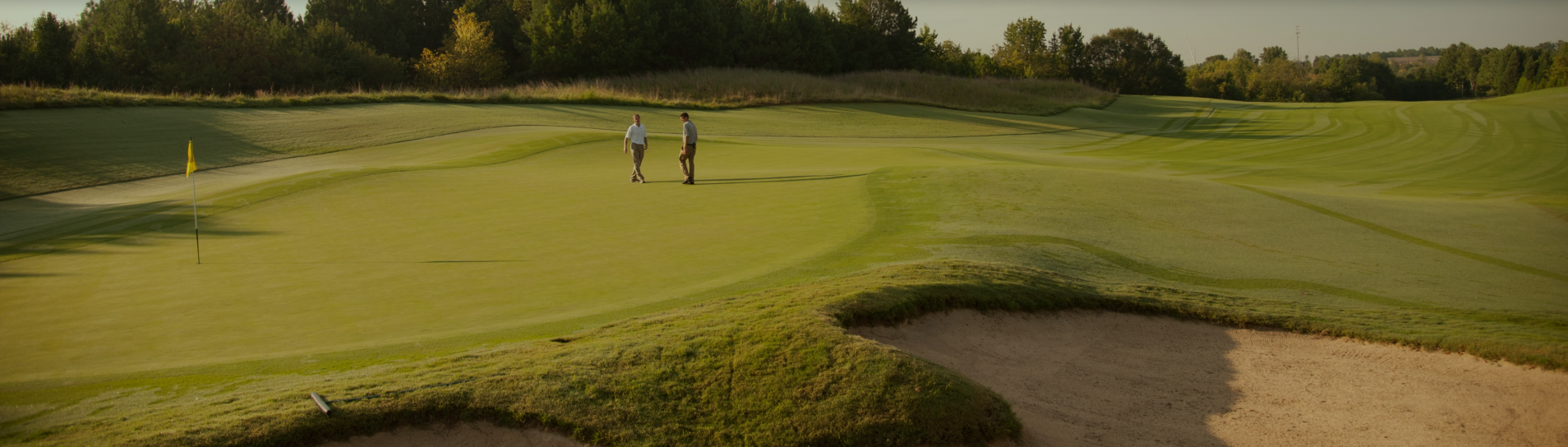
The No. 7 green was part of the original construction of 10 holes. In 1997, the second nine was completed with labor once again provided by the Frase family.
No. 7 green

The only problem was that we would have to cut through a significant portion of our newly seeded roughs and across one fairway. However, we felt we had no choice. With only weeks to go, we called in an excavation company and its trackhoe to start ripping up the land. We again encountered difficulties. At one point, we were digging nearly 12 feet just to get an inch of fall every 20 feet. Once finished, we had a great drain that took away any overflow -- and an ugly scar across the first fairway.

One final hurdle
With the grand opening days away, we believed we had tackled every possible problem. We had advertised in the local papers and sent out invitations to friends, family and associates. We felt ready -- then the storm hit. Winds came gusting out of the west at more than 50 mph. Many trees that had once been protected by surrounding woods could not stand up to the gusts. When the clouds finally broke and the winds had died, we surveyed the damage. Many trees had completely blown over. Giant limbs were sprawled across the tees. Small limbs and leaves littered the entire course. With only days to go before opening, there was little we could do. Everyone dropped what they were doing and began the clean up. Fortunately, with all the help available, we had the course cleaned up in days. By the time we finished, no one could tell a storm had recently passed through (except for the occasional stump on the course).

Finally on July 1, 1994, we opened Sable Creek Golf Course to the public. At that time we were somewhat unique because we had 10 holes. Two years later, we started on the second nine and called upon the family once again. Without fail, everyone gave another stupendous effort and succeeded in constructing the second nine while maintaining full-time jobs. I was the only one working at Sable Creek at the time. By the summer of 1997, Sable Creek finally had 18 holes.

I have no doubt that without my wife and children, I could not have succeeded in this endeavor. It was through their commitment, skill and hard work that I was able to realize my dream. In the early days, when I worked long hours to keep my large family fed, I sometimes wondered, "what was I doing with so many kids?" Today I am very proud of my family and the incredible accomplishment we achieved with the construction of Sable Creek.


Bob Frase is superintendent/owner of Sable Creek Golf Course in Hartville, Ohio, and an 18-year GCSAA member.