![]() |
||||||||||||
| home | subscribe | contact us | advertise with us | feature editorial guidelines | research editorial guidelines | gcsaa.org | ||||||||||||
|
|
||||||||||||
| August 2007 |
|
|||||||||||
Super starter Virginia layout wastes little time in getting golfers’ attention with a truly memorable opening hole.
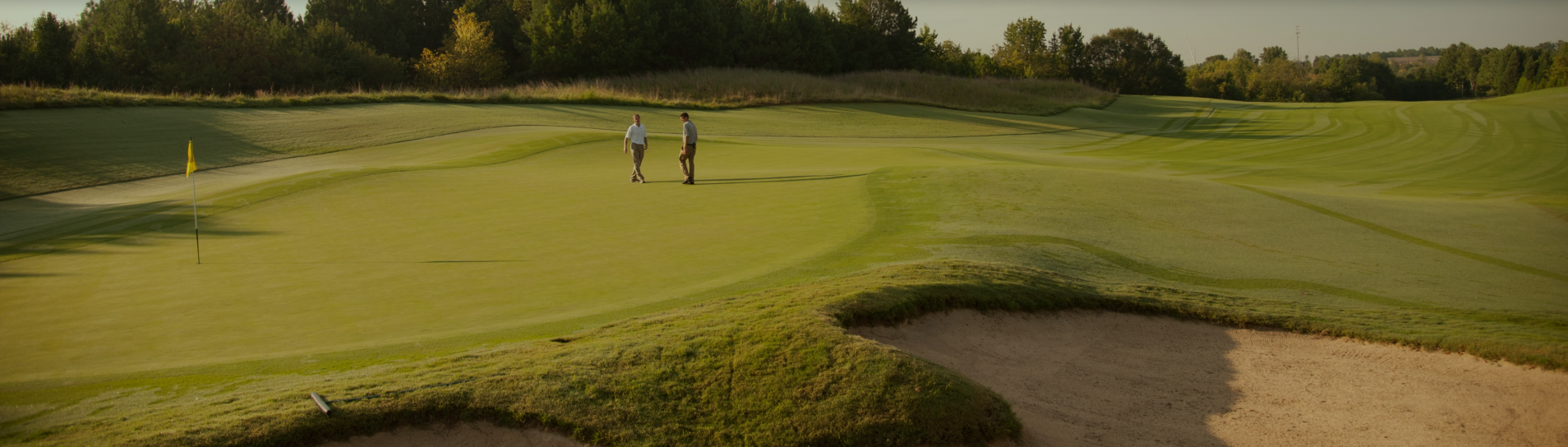
Few golf courses get your attention as quickly as Augustine Golf Club in Stafford, Va., thanks to the Mid-Atlantic gem’s opening hole. No. 1 at Augustine GC, the latest in GCM’s ongoing Unique Golf Hole series, is a medium-length par 4 that gets the golfer into the round in a hurry by providing multiple choices and challenges. The hole also showcases the key philosophies of Rick Jacobson, a member of the American Society of Golf Course Architects who designed and built the course a dozen years ago in the rolling woodlands of northern Virginia, 40 miles south of the nation’s capital. Jacobson notes that No. 1 is environmentally sensitive, ecologically responsible and designed to give the player risk-reward options. Thanks to a 50-foot drop in elevation, the hole is laid out for all to see from the tee — a split fairway bisected by a wetlands corridor that travels almost its entire length to a strategically guarded green. The downhill vista is what golf course architects like Jacobson consider a designer delight — in this case, influencing the golfer to consider the pin placement first and then plot the best strategy to get there. “It presents the entire hole to the golfer on the tee. That was something that Jack Nicklaus was always strong about, setting up the hole for the golfers to manage according to their abilities,” says Jacobson, who worked for Nicklaus Design before starting his own firm in 1991 out of Libertyville, Ill. Challenging choices
While the left fairway plays through to the green, the right side ends about 70 yards short of the putting surface and, depending on the pin location, demands a second shot to the green that must carry the wetlands, a tree and a bunker. “We set the green so that with certain pin placements, there were advantages to playing the right side versus the traditional route,” Jacobson says. The architect’s environmental accountability was considerable, as well. The wetlands corridor on No. 1 collects runoff from much of the course overall and carries it to a retention irrigation pond beyond and below the opening hole. “It was a challenge both in integrating the wetlands into the design and then the functionality of the runoff,” Jacobson says. A manageable mix “This is the fun part of the country,” the 13-year GCSAA member says in somewhat of a facetious way. “We’ve got bermudagrass fairways that we overseed with ryegrass and we’ve got a cool-season blend in the rough of bluegrass, rye and fescue that serves to stymie intrusion of the bermuda into the wetlands.” Burns, a Virginia native who has been working on golf courses since his senior year in high school in 1978, also manages bentgrass greens (PennLinks) and tees (Penncross) to complete this turf menagerie of sorts on a layout that has been an Audubon Cooperative Sanctuary since the late 1990s. Meanwhile, maintenance of the wetlands corridor on No. 1 is part routine and part improvisation. “We cut it down in the wintertime to stimulate new growth in the spring,” he says.
More is better “It does stay a little wet down there, so we’ve extended the native portion all the way back (about 300 square yards) to the cart path and near the forward tee,” he says. No. 1 can play as long as 411 yards and as short as 284 yards. No matter the choice, there’s still a lot to think about. “It’s a different hole,” Burns says. “It’s kind of an eye-opener, especially off the first tee.” |
RECENT issues
|
|||||||||||