home | subscribe | contact us | advertise with us | feature editorial guidelines | research editorial guidelines | gcsaa.org
March 2007


In this issue

On the Web

Feature articles

The Insider

Departments

Research

GCM blog

GCM's Ask the Experts

The star at Star Ranch

GCSAA’s 71st president, Ricky Heine, CGCS, follows a winding Texas road from farmland to fairways.

Photos by Carlton Wade

It’s 2 o’clock Friday afternoon. The Golf Club Star Ranch in Hutto, Texas, is going to have to manage itself for a while — Ricky Heine, CGCS, has a pep rally to get to.

It’s a 45-minute drive from the golf course to Thorndale, Texas. Heine hasn’t been to a single pep rally yet this season, and this is the last one. A Texas twister couldn’t keep him away.

Heine pulls up to the same school he attended 30 years earlier and parks his truck. Mere moments later he’s found his son Ryan, who wears a burgundy jersey with “Heine” on the back. There’s a special bond between Heine, a 25-year GCSAA member, and his middle son. Besides the love for sports and each other, there’s also the disease — Type 1 diabetes — that the two have in common. It’s a brief exchange, and the elder Heine walks inside the old gym that’s engulfed in darkness — all the windows covered with black garbage bags for effect. The cheerleaders wear glow-in-the-dark bracelets and jump around, barely visible to one another.

Heine navigates the darkness to find another that bears his name. This time it’s his wife, Jana. But she can barely say hello: Two 4-year-olds, afraid of the dark and of the Thorndale bulldog mascot, cower within her arms. The other preschoolers in her class revel in the noise of the pep rally.

As the pep rally ends — another spirit stick won for the seniors — Heine sees the husband of his high school science teacher, Linda Culp. Thirty years ago, Linda Culp told Ricky he was too smart to bother with turfgrass.

Heine is in a nostalgic mood, so he wanders through the school halls to Culp’s room to say hello. Like the gym, the old science lab has been replaced with something bigger and nicer. But it’s still the same ol’ Mrs. Culp.

The two see each other weekly, as Culp’s grandson is the quarterback of Ryan’s football team. But it’s been a long time since Heine has sat down in her science classroom. His daughter Jordan sits there daily.

“I knew Ricky would do something great,” Culp says of the former class valedictorian. “He had too much intelligence not to do something great.”

Back then, Heine was shy and introverted, Culp says — a bookworm. Today, the man doesn’t know a stranger. Always smiling, always laughing.

But some things don’t change. The day Culp met him, 14-year-old Ricky Heine was already managing turf.

Now, he’s the president of turf managers.

One second- and one third-place state high school tennis finisher (Jared and Ryan), a budding cross country star (Jordan), a former volleyball champ (Ricky) and a former track standout (Jana); the Heine family likes to be competitive. “They keep score for a reason,” Ricky Heine says.

Blame Bobby
There are 21 years between Ricky Heine and his older brother Bobby. Bobby’s children are closer in age to Ricky than his brother. The gap in years has made the two more friends than brothers, Bobby says.

Bobby Heine already was a superintendent when Ricky was born. He made a name for himself in the industry on golf courses in Florida, Oklahoma and Missouri — even hosted a PGA Tour event in Kansas City.

So when Ricky was old enough — age 13 — Bobby sent his little brother a project to keep him busy: a truckload of zoysiagrass sod.

The idea was to plant the sod on the family farm, and Ricky could take care of it and sell it as an extra source of family income. But the Heine family didn’t have a sod cutter, a forklift or even a mower at the time, so Heine got his first experience in staffing a crew. He went to school and asked six reliable boys to come out to the farm on a Saturday morning. Together, they cut the sod with machetes and planted the turf. Later, he’d hire kids to help him load the sod onto an 18-wheeler, then they’d use the turf farm as the golf team’s personal driving range.

Heine considered maintaining the sod not as a chore, but as his passion. “My brother would have to tell me to work less (on the sod),” Heine says. “To some degree, I was just a perfectionist. I would edge it like it was a bunker or a fairway — perfect lines. It was overdone.”

Bobby Heine’s whim of sending his little brother a truckload of sod sent him down a career path that would be Ricky’s passion for the rest of his life.

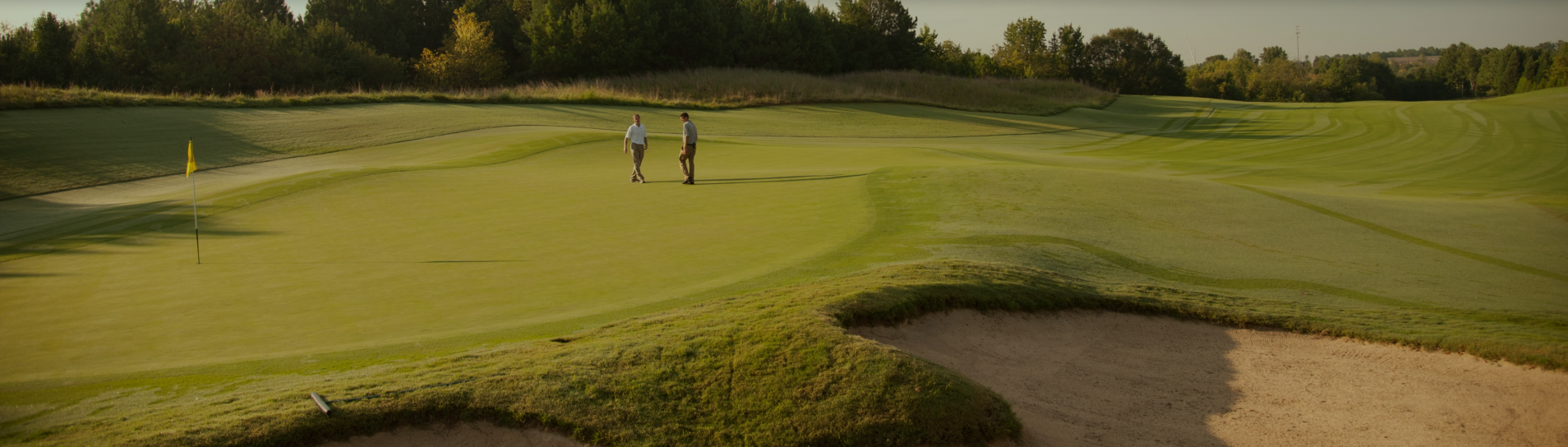
The first hole at the Golf Club Star Ranch.

From sod farmer to Star Ranch
Heine again followed his brother’s footsteps after high school, and went to Texas A&M, graduating in 1985 with a B.S. in agronomy. The sod farm went away after 10 years, though some of the turf remains at his home to this day. “Dad kept moving in the fence so the cattle could eat on the zoysiagrass,” Heine recalls.

It’s been a long road from those days as a high school sod farmer to his current position as the general manager of the daily fee Golf Club Star Ranch outside of Austin. After college, Heine’s first job was as an assistant superintendent at Quail Valley Country Club, south of Houston. Heine learned a lot about his golf game at Quail Valley, playing regularly with superintendent Jim Wagner, who was a scratch golfer, and assistant golf professional Billy Ray Brown, the 1982 NCAA Division I Golf Champion and now a golf television sportscaster.

“Playing with these two affirmed my decision to keep the day job — these two were serious players,” Heine says with a laugh.

From Quail Valley, Heine went to Elkins Lake Country Club in Huntsville, Texas, in 1986 for his first stint as a superintendent. After Elkins Lake, Heine moved closer to his hometown by moving to Austin and becoming the superintendent at River Place Country Club. At River Place, Heine was able to play the role of construction superintendent as well as golf course superintendent.

In the 12 years Heine was at River Place, Austin grew. His 45-minute commute stretched to 80 minutes. So when Star Ranch was breaking ground on the north side of the city, considerably closer to his home in Thorndale, Heine wanted to get involved.

Heine and one of the Star Ranch partners, Joe Cotter, drove around the farmland that would eventually become the course it is today. Though the course didn’t necessarily need a superintendent yet, Cotter and his partners were so impressed by Heine they hired him to head construction of the golf course.

“His attention to detail is as good as anyone I’ve been around in my 30 years in the business,” Cotter says. “We’d interviewed a lot of people. Most that I’d hired over the years didn’t have the attention to detail as well as the knowledge of the construction process. After checking with people who had worked with him in the past, we saw he had very good credentials. Normally, when we build a golf course, we bring in the superintendent before we start grassing. But with his attention to detail, we thought he’d be good for the whole process.

“And if you’ve seen the course,” Cotter continues, “you can see that this early investment paid off.”

From superintendent to general manager
At Star Ranch, Heine developed a reputation not just for being a good superintendent, but for being a student of the golf business as well.

“Ricky’s strength is to understand both sides,” says Dale Morgan, head golf pro at Austin Country Club, and Heine’s old manager at River Place. “He’s the kind of superintendent that every golf pro wants. Detail-oriented, member-oriented. Highly detailed in agronomy, but realizes you have to get players around the course to make money.”

After a few years, Heine moved from his office in the maintenance facility to the club house to take over as the general manager of Star Ranch.

“I think he’s done his homework. He’s tried to get better in all aspects of his career,” says Tom Kite, 1992 U.S. Open winner and a colleague of Heine’s. “He tries to get better, and he learns. Plus, he has great people skills.”

Heine’s staff echoes the sentiment about his management style — he allows his staff to make decisions on their own, and he also treats everyone in the facility like family.

“What I like about him and Tim (Timmerman, Star Ranch owner) is that it’s a family-oriented business, very tight-knit,” says Rob Fulford, head golf professional at Star Ranch. “Ricky believes very strongly in a work/life balance. It’s family first for Ricky. And that mentality goes all the way down to the assistants. It’s a rarity to have that.”

“Ricky gives you opportunities and lets you run with it,” says Samantha Fulford, assistant manager at Star Ranch and wife of golf pro Fulford. “And if you prove yourself, you get more opportunities.”

The management team at Star Ranch (from left to right): Megan Woodard, sales; Rob Fulford, director of golf; Samantha Fulford, assistant manager; Jose Trevino, mechanic; Heine; Rogelio Denova, assistant superintendent; and Travis Carlson, superintendent.

Heine is proud that the six people who make up his management team at Star Ranch have 59 years total experience working together. In fact, three of those six worked with Heine before Star Ranch existed.

“Building a close team of people who share their success and failures together for this ownership and the Timmerman family is very important to me,” Heine says. “It’s what makes me enjoy waking up and coming to work every day.”

Goals as GCSAA President
Heine is quick to want to move on from his personal and professional life to talk about his goals for his term as president of GCSAA.

“That’s what members care about,” Heine says.

Heine has three main goals for his term as the 71st president of GCSAA:

  • His first priority is for GCSAA chapters to be successful, and to measure that success with GCSAA’s indicators. “When chapters grow and are successful, that’s when GCSAA is successful,” Heine says. “Our membership both locally and nationally is pretty stagnant. We have to find a way to grow that membership, and even bring back some people (who left) four years ago.” Heine wants to see attendance, participation and engagement grow for chapters. To do this, chapters need to show an excitement and reward for being involved, he says.
  • Second is positioning GCSAA members for recognition, value and reward. “We’ve often promoted ourselves to ourselves in recent years,” Heine says. “PDI has evolved now, and members are gaining these certification credits to be classified as Class A members and certified members. Now we’re going to promote those achievements to the people that matter — not to ourselves, but to owners, avid golfers, influential board members at clubs.” Heine says that Star Ranch owner Tim Timmerman — a person he considers extremely involved in the management of the golf club — had never heard of GCSAA until Heine started serving on committees, and that concerns him. Heine stresses that the awareness of GCSAA has been growing, but now, he says, he wants to kick GCSAA’s visibility into a higher gear.
  • Finally, Heine wants to make sure superintendents believe that the Golf Industry Show — which most recently added the Club Managers Association of America to its growing ranks — still feels like a show for superintendents. “It is very important for our membership to benefit from this partnership,” Heine says. “The partnership was not done for the GCSAA staff or for money or for the board of directors. It truly is to grow the respect, value and position of superintendents. If that doesn’t happen, then we won’t have an industry show like that.”

Dealing with diabetes
At age 17, during a routine physical for football, Heine learned he had diabetes.

Heine’s middle son Ryan developed the disease when he was only 5.

“If I had one wish in the world, it would be that he would not be a diabetic,” Heine says. “It’s what I worry about most. I know what’s happened to me, and I know that I’m lucky that I didn’t die a couple of times… and I just hope he doesn’t ever have an episode like that.”

Both Heines take insulin to control their diabetes. Ricky Heine says that since he first started taking insulin almost 30 years ago, major medical advances have made it easier to deal with the disease.

Heine recalls an instance during college when he went to play golf, got caught up in his round and forgot to eat the lunch that Jana had packed for him. He doesn’t remember playing the final couple holes of golf or getting into his car to leave the course. His critically low blood sugar level caused him to drive to the wrong apartment complex and pass out in his car. Eventually, someone called the police, suspecting Heine was drunk. The police gave Heine a ride home and Jana fed him a candy bar to bring his blood sugar back to a safe level.

After the ordeal, Heine woke up thinking it was all a crazy dream. It took an angry wife to set him straight: He had just survived a real-life nightmare.

Today, Heine has a positive outlook. He stresses that diabetes can be controlled much easier these days, and that it forces him to live a healthy lifestyle.

“I have a plan and a guideline and goals, like I do with family and work,” Heine says. “You can manage diabetes to be your friend instead of your enemy.

“I’ve got my family and Star Ranch and diabetes. And diabetes is 7, 8, 9, 10, 11 and 12 on my list of concerns,” Heine says. “You can make diabetes an asset. You know how you can do that? Eat decent, and work out. Then your body is naturally fighting against high blood sugar. …A lot of people don’t have that reason to help them, and their eating habits get worse and worse. I think any diabetic in the world can use their diabetes as a positive.”

Heine has helped Ryan deal with the disease, and Ryan already has had a successful high school athletic career. As a junior, Ryan played a significant role on the football and basketball teams, and last year he led his mixed doubles tennis team to third place in the state.

“He helps me a lot, gives me advice from his own experiences,” Ryan Heine says of his father. “Plus, he inspires me because he’s getting better and better at controlling his diabetes as he gets older. He tells me that it’s easier for him because he’s older and more in control of what his body is going to do, while I’m younger and my body is still changing.”

Cover of a magazine
It’s game time. Ryan Heine’s Thorndale Bulldogs are on the road to face off against the Granger Lions under the Friday night lights that are so well known in Texas.

Heine arrives with his wife and oldest son Jared, who like his younger brother also was a state tennis finalist, and is now a freshman at Texas A&M (Heine’s youngest, daughter Jordan, already was on the road to compete in the state cross country meet). At the game, he sits in the visitor’s bleachers with Jana’s parents and his two older sisters, Betty and Debbie. Ryan Heine has his own private cheering section.

The game is a dramatic one as the Bulldogs forge a gutsy come-from-behind 19-14 victory. With every hit Ryan Heine deals out on special teams, dad and brother are up out of their seats, screaming at the top of their lungs. Only mom Jana is arguably more excited.

“He’s passionate about GCSAA,” Jana Heine says, between special team hits, about Ricky’s future as GCSAA president. “He cares about doing what is right, not what is always the most popular. I’m excited for him.”

After the game, players and family meander on the field, enjoying the last win of the regular season on a rival’s home turf. Ricky Heine slaps Linda Culp’s grandson on the shoulder pads and tells the quarterback he had a great game.

Culp, who has seen numerous future teachers and lawyers come through her classroom in 35 years, is surprised to see that Heine still has the same journalist from earlier in tow. To her knowledge, not one of those teachers and lawyers has ever been on the cover of an international magazine.

“I really didn’t know there was that much involved in what (Ricky) had done,” Culp says. “I always hated giving out 100s… but sometimes, you have to.”

The superintendent’s
superintendent

With Heine in the GM seat, turf care falls to Star Ranch superintendent Travis Carlson.

Heine’s favorite place on the golf course is No. 15, a 170-yard par 3 with a limestone front. During the construction phase, Heine decided to pinch a few pennies by trying to break and shape the limestone rocks on his own. It turned out to be so easy he brought his three kids to the course to have fun breaking the rocks with him.

During Travis Carlson’s senior year, the Thorndale football team looked fine — the football field did not.

Ricky Heine came to the aid of his alma mater, and with the assistance of the football team, brought the field back to life. Carlson took note of what Heine did, and today the two former Thorndale football players team up to make the Golf Club Star Ranch a winner.

“I always knew where Ricky worked and what he did,” Carlson says. “Everyone in town knew the success he had.”

After graduating from Texas A&M with a degree in agronomy, Carlson took an internship at ColoVista Country Club in Bastrop, Texas, then came to Star Ranch in 2000 to be Heine’s assistant. Later, Carlson went to Elkins Lake CC to be superintendent — the same course where Heine got his first superintendent job. A little over a year later, Heine called Carlson to get him back at Star Ranch, this time as his head superintendent.

“I always wanted to come back to this area,” says Carlson, a nine-year GCSAA member. “I knew the course, knew the crew and enjoyed working here.”

Now it’s up to Carlson to keep the 18-hole high-end daily fee course looking its best. Word around Austin is that the greens at the 7,017-yard par-71 course are about the best in the area. Golf course architects Roy Bechtol and Randy Russell built the course with a layout like a propeller — or like the course’s namesake star — so that the golfer faces winds from every direction.

“What we were trying to do was make a fun, yet traditional golf course,” Bechtol says. “We have five sets of tees out there — trying to build a place where people want to come back. It plays easier than it looks; we did that on purpose.”

Both architects attribute a lot of the beauty of the course to Heine’s keen eye and dedication.

“We have a photo of Ricky busting rocks with his kids, when there was nothing on the site,” Russell says. “He sees things. We were ready to claw out those rocks; he saw a sculpture.”

Heine’s vision also has superintendent Carlson on his toes.

“(Heine’s) very detail-oriented, and he cares a lot about everything we do out here, treats it like it was his own,” Carlson says. “One thing’s for sure — there’s nothing you can pull over him."


Seth Jones is GCM’s senior associate editor.

RECENT issues

February
2007

January
2007