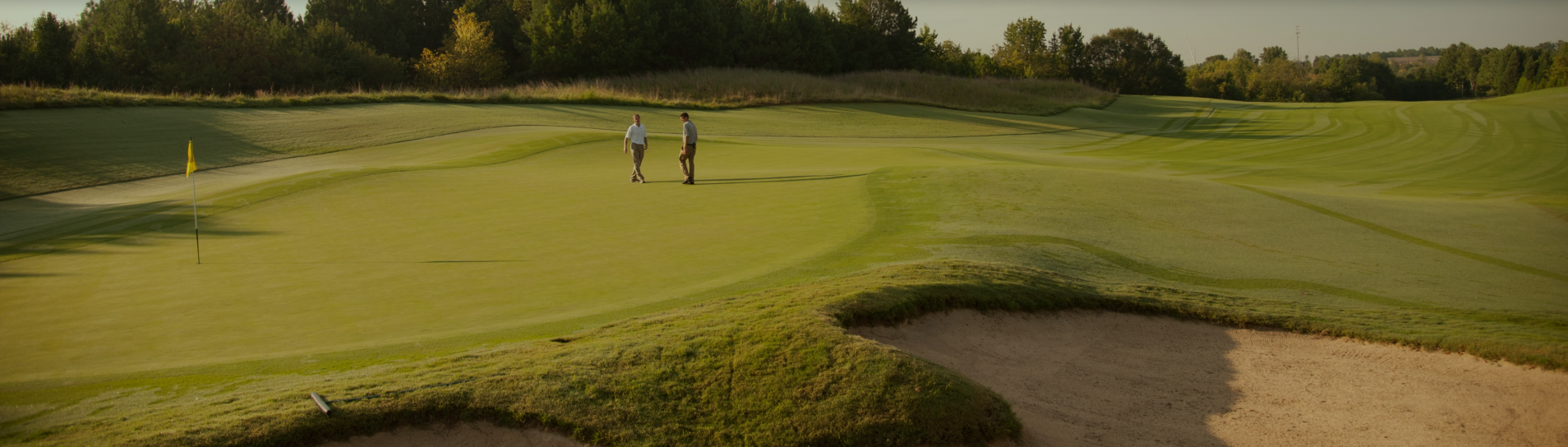
California dreamin'

This step-by-step guide and practical advice will help see you through the process of
California-style green reconstruction.

Bob Costa, CGCS

Related Articles

{short description of image}2000 Leo Feser award candidate

Key Points

{short description of image}The written plan for reconstruction should include objectives, procedures, a summary of materials and labor, a time line and design specifications.

{short description of image}Don't compromise on adequate sand. The California green requires laboratory testing for particle size distribution, infiltration rate and moisture retention.

{short description of image} To avoid concerns about disruption of play, start planning a temporary green well in advance.

{short description of image}Varying the depth within the subgrade will affect moisture retention.

{short description of image}For drainage, the most critical factors are tile spacing, slope and drain orientation.

{short description of image}Develop a grow-in schedule that addresses fertility, mowing height and topdressing.

Superintendents have been fired over it; green committees have spent countless hours arguing over it; it's even caused memberships to become fragmented and divided.

It's called green rebuilding, and it's one of the most controversial subjects in golf course maintenance. Why is it so, and how can you avoid getting caught up in the green rebuilding nightmare?

Much of the controversy surrounding green reconstruction exists because of a lack of knowledge -- both of the conditions that cause existing greens to fail, and the solutions and techniques currently available to improve their playability. In addition, there is a great deal of reluctance by members and owners to engage in reconstruction because of the anticipated disruption to the golf course.

My experiences have taught me that a well-conceived and well-communicated written plan can go a long way toward reducing the stress and anxiety often associated with green rebuilding. After nine successful projects, the process has almost become routine.

Assess the problem, develop a written plan
One thing I've learned is that you had better have a clear understanding of the problem and how you intend to solve it. Generally, green reconstruction is proposed by a superintendent or recommended by a green committee for one of the following reasons: to correct inadequate size, to "modernize" a facility, or, as is most often the case, to improve drainage or solve agronomic problems rooted in drainage.

Whatever the reason, I recommend that you clearly identify -- in writing -- the basis for reconstruction and that you include an explanation of how the reconstruction will address and solve any one of these problems.

Not so fast -- it's not time to fire up the dozer yet. The only tool you'll need for a while is the keypad at your computer. Assessing the problem is only phase one of your written plan. You'll also want to include a discussion of the project objectives and procedures, a summary of materials and labor, and a project time line. Finally, you'll want to spell out the design specifications, which should include green size, shape and contours, and any additional renovation to the surrounds, irrigation or bunkers.

Developing a written plan may seem like a time-consuming step, but you'll be surprised how valuable a resource it will become. Use it as a construction guideline for your staff and contractor, as well as a valuable information tool for your owner, manager or green committee.

Locate and sample construction materials
Another reason there is so much apprehension associated with green reconstruction is that it doesn't always work. There are countless examples of greens that have been reconstructed to USGA or California recommendations that have subsequently failed. Invariably, it can be attributed to one of two things: improper construction techniques, or the use of inadequate construction materials.

Locating adequate sand for construction can sometimes be a challenge, and how close to home you find it will affect the cost. Regardless of the source and its location, price should never be the determining factor. The primary objective should be that it meets the specifications for construction. There is no room for compromise here.

The California sand green, originally developed in the late 1960s, requires laboratory testing for three soil properties: particle size distribution, infiltration rate and moisture retention. Sands that meet these specifications will provide adequate drainage and good aeration without being too droughty. The University of California Cooperative Extension Service publication, "The Sand Putting Green Construction and Management," details the specifications. Assistance can also be obtained from various labs specializing in sports turf management.

The first steps in the construction process include removing sod from the perimeter of the green, removing the existing greens mix to 12 inches and establishing the subgrade.
construction

In addition, careful consideration should be given to the pea gravel used for bedding the drainpipe. Gravel that is inadequately sized may allow sand to migrate through the tile perforations, causing the drain network to fail. Without a free-flowing drain network, anaerobic conditions prevail, recreating many of the problems that may have led you down the rebuilding path in the first place.

A good temporary goes a long way
If course disruption is one of the major reasons why owners and members oppose greens reconstruction, why not address those concerns from the beginning? I'm convinced that golfer acceptance of green reconstruction is greatly enhanced when a quality temporary green is provided.

The key is to start preparing months in advance. Begin by developing a green that is adequately sized. A 1,000- or 1,500-square-foot circle probably won't please anybody. Be creative -- make it as large as possible and don't be afraid to add contours. If necessary, overseeding with bentgrass or Poa trivialis can improve turf quality. And regular topdressing is a must.

When it comes to maintenance, the program should be the same as for all the other greens, including mowing frequency and cutting height. Depending on your perspective, the ultimate compliment, or criticism, is to hear golfers say, "That temporary is the best green you've got out here." Ouch!

Once the drain network is in place, the most difficult phase of construction is over. The most critical factors for drainage are tile spacing, slope and drain orientation.
construction

It's construction time
The morning construction begins always brings a special excitement, a true sense that something special is about to unfold. The process begins by painting a perimeter line depicting the final green shape. Using a sod cutter, the painted line is traced, and the cut sod is thrown to the center of the green. Removing the sod cleanly defines the green's edge and eliminates tearing and ripping of the turf that is part of the collar.

Now we're ready. After all the planning and preparation, it's time to begin the excavation and say good-bye to a green that has likely been a source of problems and frustrations for years.

Using either a loader or dozer, remove the old greens mix or native soil to form a basin 12 inches deep. Maintaining a uniform depth of 12 inches is critical to the construction process. Varying the depth within the subgrade will result in a nonuniform sand profile and will ultimately affect moisture retention. Surface contours, whose function is to add character and strategy to a green, must therefore be built into the subgrade. Never create surface contours by varying the depth of sand. It's equally important that the subgrade be adequately compacted. Any settling of the subgrade means eventual settling of the finish grade. Make no compromises here.

After setting the grade stakes to ensure a consistent sand depth, the sand is placed and graded to the marks. Sprinklers can
be used to compact the sand to avoid
future settling.
grade stakes

One of the primary benefits of the California green is its ability to rapidly remove excess water. This is accomplished through the use of a sand growing medium combined with an internal drainage system. Although the concept may appear simple, selecting the right sand and properly installing the drain system require careful consideration. Fortunately, in California we have numerous sands available for use in greens construction. It's best to consider and sample only sands that meet the design specifications. Be certain to confirm the supplier's test results with your own laboratory testing. In addition to particle size, infiltration rate and water retention, an analysis that includes particle shape and sodium content can be of great value.

When it comes to drainage, several factors need to be considered. Tile spacing, slope and drain orientation are perhaps the most critical. For accurate layout of a drain system, you'll need to shoot elevations of the entire subgrade. This will help you determine which direction the main line and lateral lines should be oriented. Ideally, lateral lines should face the opposite direction of gravitational flow to capture the most water. Don't forget to include perimeter or smile drains in areas where water is likely to collect. These can be tied directly into the main drain or function as separate drain systems. Determining the spacing of lateral lines is a function of the percolation rate of the soil. For sand, 15 feet O.C. (on center) is sufficient.

Finally, it's one thing to capture water in drain tile, but it's another to move it. All drain lines must maintain a minimum of 1 percent fall. To protect the drain tile from sedimentation, both lateral and main drain lines should be bedded and covered in pea gravel.

With the drain network in place, the most difficult phase of the reconstruction is over. Now the focus shifts to placing the sand and developing the finish grade for establishment. As I mentioned earlier, maintaining a consistent sand depth of 1 foot ensures uniform water retention throughout the green profile. This is easily accomplished by randomly placing grade stakes in the subgrade and marking the grade at 14 inches (the extra 2 inches allows for settling). The sand can now be placed and graded to the marks. As the sand is positioned, be certain never to track directly on the subgrade or drain tile. It's a costly mistake and a guarantee for failure.

Finish grading requires time and patience. First, you'll need to compact the sand to avoid any future settling. Small impact sprinklers do a great job and can be left to run continuously throughout the day and night. With the sand firm and compacted, finish grading can be done with one of many methods and techniques.

Through the ingenuity of our mechanic, we have developed a brush attachment and screen that attach to the rear of the sand pro. Traveling in small continuous circles seems to provide the best finish.

Whatever method you choose, don't stop until you think it's perfect. Then keep going until it's better.

To seed or not to seed
Valid arguments can be made for and against using seed or sod to establish putting surfaces. I suppose the bottom line is that if cost is a concern and you have the luxury of time, seeding is likely your best alternative. We have done it both ways with equal success.

The final steps are placing the washed sod and following through with a grow-in schedule that addresses fertility, mowing height and topdressing.
washed sod

My personal preference is sod. I have found it to be agronomically less complicated, and our customers benefit too. As we all know, the primary advantage of sod is that it establishes more quickly. With respect to greens reconstruction we have found this to be true, and on average, we've opened greens 30 to 45 days sooner using washed sod.

Keep it up during grow-in
Regardless of the method of establishment you choose, it's most important that your grow-in schedule addresses fertility, mowing height and topdressing.

With respect to fertility, a well-conceived nutritional program is a must and should be developed on two basic premises: the need to accelerate growth and density, and the need to provide both nutrition and an organic component to an otherwise sterile growing medium.

With that said, grow-in fertility programs should include both soluble and organic fertilizers that provide all the essential nutrients, including, Ca, S, Mg and minor elements. Rates of application should be excessive, as much as .5 pounds N per week. I recommend using an organic fertilizer during the summer months and applying soluble materials over the top, in either a liquid or granular form. After 90 days, it's wise to consider a soil or tissue sample as a means of monitoring fertility. Slight adjustments can be made based on the results.

CGCS Bob Costa's months of planning, scheduling and construction paid off with a beautiful new California-style green at Laguna Seca GC.
laguna Seca

Of course, the byproduct of this judicious use of fertilizer is excessive shoot growth, so be prepared to mow and mow and mow. Whether establishment is by seed or sod, I like to begin mowing at ½ inch, reducing the mowing height weekly thereafter. Slight scalping usually begins to appear at about ¼ inch. The cutting height and reduction frequency need to be monitored carefully at this point, but don't be overly alarmed by scalping -- it's inevitable at least until the green is uniform and smooth.

Topdressing should begin as soon as the turf is dense and well rooted. The objective is to firm the surface and level any imperfections. Light to moderate amounts of sand lightly brushed into the canopy seem to work best. Applications can be as frequent as every two weeks.

Before you know it, it's opening day, and the months of planning, scheduling and construction are finally over. There is an excitement in the air much like when you began the project, and everyone is talking about the new green. The challenge isn't over, not by any means. But if you've done it right, there is comfort in knowing that it's no longer your worst nightmare. In fact, it's sweet dreams.


Bob Costa, CGCS, a 16-year GCSAA member, is VP director of golf management for the Lombardo Group in Monterey, Calif. This article was previously published in the May/June 1999 issue of California Fairways.