![]() |
||||||||||||
| home | subscribe | contact us | advertise with us | feature editorial guidelines | research editorial guidelines | gcsaa.org | ||||||||||||
|
|
||||||||||||
| October 2007 |
|
|||||||||||
Double trouble There’s no safe side to Prairie Landing’s two-headed No. 5.
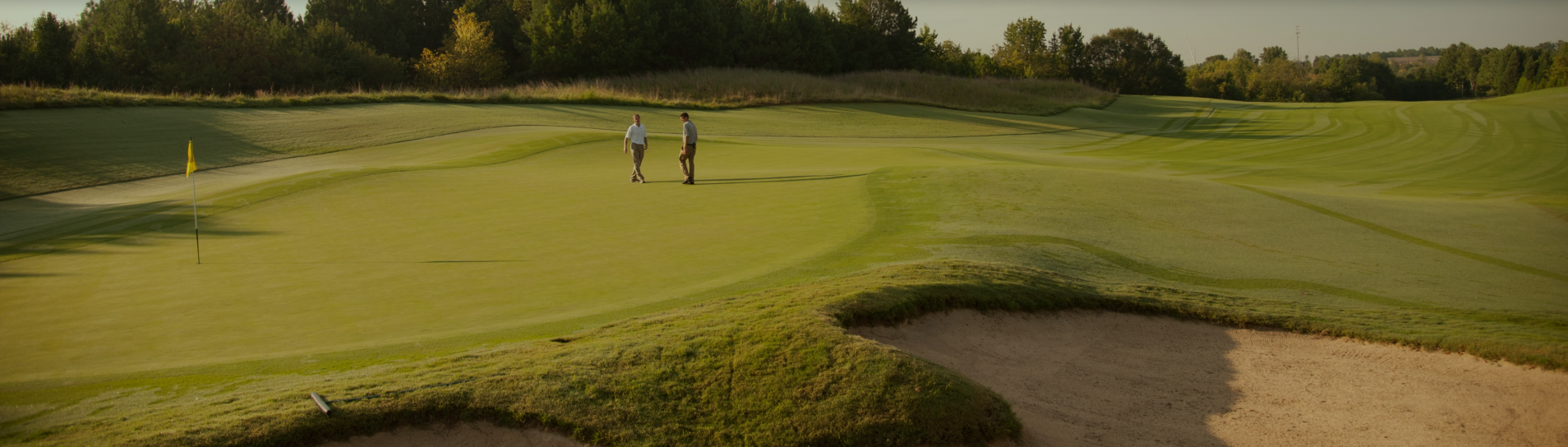
Golf holes that feature shot options from the tee are becoming more and more common across the country. What’s a bit uncommon about the fifth hole at Prairie Landing Golf Club in West Chicago, Ill., is that the choices are like trying to decide on the lesser of two evils. “A lot of head-shaking goes on there. There’s a true risk/reward mystique,” Anthony Kalina, the Class A superintendent at Prairie Landing since 1995, says of the relatively short par 4 (from 406 yards at the tips to 300 yards at the fifth and front tee). Thus, the damned-if-you-do, damned-if-you-don’t approach makes Prairie Landing’s No. 5 a prime subject for GCM’s ongoing Unique Hole feature.
Prairie flower Prairie Landing is a true prairie links-style layout and, in fact, Charlton says it was somewhat modeled after the Great Plains gem, Prairie Dunes, in Hutchinson, Kan. Alphabet soup “We called the project ‘Planes, Trains and Automobiles,’ which was popular then,” says Charlton, who has been with RTJ II since 1981. “We dealt a little bit with everybody, that’s for sure.” The course’s proximity to the airport is the root of two main issues. One, parts of the golfing area are also in play for aircraft entering a runway’s landing glide zone, which in turn brings into play the FAA’s restrictive air space requirements for that facility. That means anything higher than 12 to 15 feet in the glide zone, including trees, buildings, mounding topped with tall grasses and even flying golf balls, are in violation. The consequences of the glide zone affected the project threefold. Some mounds, including those around the tee area at No. 5, had to be shaved down. One of three practice holes, a 107-yarder, had to be eliminated because of the fear of high-launched iron shots (the hole was joined within a longer practice hole by adding par-3 tees). Finally, changes in some rough grass selections had to be made because some were attractive to birds, which would be a danger to incoming planes. The other issue involved the need for stormwater retention management because of the huge amount of runoff from the airport and surrounding area into the golf course layout en route to an off-property watershed. Charlton and the Corps of Engineers came up with the creation of a canal, or linear lake, to meander through the course. It became an immediate benefit to the project. “We routed the stream through the golf course,” Charlton says. “It was an opportunity to create an active hazard, not only for the golfer, but for great habitat and great stormwater control.” Kalina notes that the canal has about 4½ miles of shoreline and affects 11 holes, none more dramatically than No. 5, where the hazard bisects basically the entire hole from tee to green, splitting the fairway down the middle and curving just enough to front the green at the tip of a slight dogleg left.
Damned if you do … “If you play left, it’s instant anguish and if you play to the right the anguish comes on the second shot,” says Kalina, a 22-year GCSAA member. He adds that the left-hand tee shot is the most challenging because it requires a forced carry over the hazard (up to more than 200 yards depending on the choice of tee box) to reach a landing area that then offers a relatively straightforward approach to a long, narrow green; while the play to the right is to a much easier fairway, the second shot is longer and must carry the hazard to a green that resembles the 12th at Augusta — wide, shallow and running away from the golfer diagonally. And, in the words of Charlton, “If you’re going to chicken out on the drive (right option), then you’re going to pay the price on the next shot. If you want to be a hero on the drive (left), it can be worth it. I like to make people aware of what their missed shots might do and give them an option to play around hazards, be conservative on one shot and more aggressive on the next.” Right care for right ingredients The superintendent says the chief twist to the maintenance of the fifth hole is that there are actually two of everything —double fairways, landing areas and drop zones along the hazard. “For starters, that’s a lot of divots to take care of,” he says. Naturally, the intensive work is saved for No. 5’s considerable portion of the stormwater canal, which handles drainage from no fewer than 6,200 acres of surrounding territory. The on-course stream can reach a depth of 11 feet in soggy times. “Our problem when the water levels go up is that they go down so slow because of the system’s weirs, or dam structures, that control the flow,” Kalina says. “That might mean the turf on the slopes is inundated for several days, plus stream-bank erosion takes its toll.” But for the most part, like the rest of the layout, No. 5 has been very resilient over the years. “Bruce really put together a great golf hole,” Kalina says. “It’s really difficult to make par; even if you’re smart, it’s easy to make bogey. A bad shot is truly a penalty. It’s really great architecture.” The test of time “I’ll give credit to Tony and his staff,” he says. “They’ve done a good job of knowing what our design intent was and in correctly maintaining the vegetation in and around the canal to eliminate visibility issues. It’s held up the original intent very well.” Charlton, who is currently vice president of the executive committee of the American Society of Golf Course Architects, adds that because of advances in equipment technology, he knows more golfers are challenging the left option on the fifth tee than he probably envisioned 15 years ago. But that’s not a bad thing, he says. “That OK with me. I like having people stand up there and think they can do it. That’s what the hole is all about.” |
RECENT issues
|
|||||||||||