home | subscribe | contact us | advertise with us | feature editorial guidelines | research editorial guidelines | gcsaa.org
October 2007


In this issue

On the Web

Feature articles

The Insider

Departments

Research

GCM blog

GCM's Ask the Experts

The lost Ross

Diligent research and a careful restoration
return a Jacksonville course to its former greatness.

Photos courtesy of San Jose CC

The original Donald Ross-designed golf course was in its burial clothes, much of it literally underground, unceremoniously buried along with memories of past glory, when the light finally shone on officials at San Jose Country Club in 2005.

After the Jacksonville, Fla., club decided to institute a long-delayed reconstruction of its dilapidated greens, Col. Ray Benson (Ret.) presented his fellow members with proof that a classic golf course lay unseen on their property. It only needed resurrection.

Arguably the greatest of all golf course architects, the Scotsman Ross had walked the property, masterfully routed 18 holes through 115 acres of what was planned as a resort, and compiled extensive hand-written notes and drawings of the golf course.

Benson discovered and photocopied all this material at the Tufts Archives at Pinehurst, N.C., which maintains an exhaustive library of Ross’s projects around the country. Meanwhile, the club possessed aerial photographs from 1928 and from the 1940s, ’70s, ’80s and ’90s, showing the rapid “de-Rossing” of San Jose CC.

Early on, most of Ross’s bunkers were filled in to save on maintenance costs since the planned resort never materialized. Then, over the years, the remaining bunkers also were filled in, even after the newly formed San Jose CC bought the course. A 1988 renovation departed even further from the original design, focusing instead on aesthetics and building a system of irrigation ponds.

Like homeowners discovering a lost Van Gogh in their attic, San Jose CC members took stock of this forgotten blessing and decided to take their greens-renovation project to a whole new level.

By immersing himself in all things Donald Ross, architect Dan Schlegel was able to return San Jose CC to its original design. “I was able to get inside the mind of Ross, at least read what he intended,” Schlegel says.

Reviving the patient
Enter golf course architect Dan Schlegel of Edgewater, Md., a member of the American Society of Golf Course Architects. The club hired Schlegel in the spring of 2004 to guide what had morphed into a total restoration and reconstruction. San Jose members had approved the project and the membership assessment of $3 million necessary to carry it out.

“They realized they had a Ross but not a Ross,” Schlegel says.

“Back in ’88, when the last renovation was done, people weren’t interested in maintaining a Donald Ross-designed course,” says San Jose superintendent Clayton Estes, CGCS, a 24-year member of GCSAA.

But, 16 years later, the members received the revelation. “Our marching orders became for Dan to do research and put the course back in place with today’s technology,” Estes adds.

As San Jose’s president, Judge Charles Cofer, says, “Our members are very aware of who Donald Ross was, and they are proud to be a member of a club with a Ross-designed course.”

Schlegel immersed himself in all things Rossian, from San Jose and beyond. He spent many hours in the Tufts Archives poring over Ross construction drawings and visited such Ross creations as Pine Needles in Pinehurst, N.C.; Aronimink Golf Club in Newton Square, Pa.; and Augusta (Ga.) Country Club that remained unchanged. They became Schlegel’s classroom until he could return to San Jose “feeling” Ross’s touch and strategic thinking.

“I was able to get inside the mind of Ross, at least read what he intended,” Schlegel says.

The Ross challenge
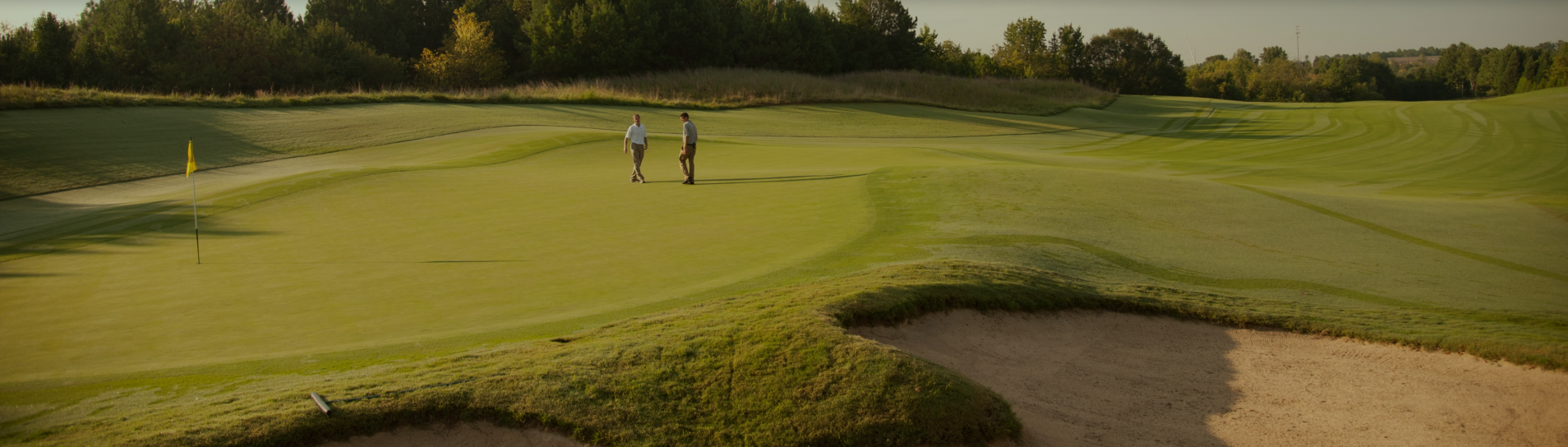
It was crucial to do so. Golfers familiar with Pinehurst No. 2 might think all of Ross’s greens were domed. Not so. Indeed, he often designed bold contours, including a par-5 at San Jose that boasts a diagonal swale, 2½ feet deep, running away from the shot to the back of the green, which Schlegel built again and called “Ross’s Trough.”

Modern golfers often look aghast at blind shots. But, in describing a par-3 at San Jose, Ross wrote that a bunker fronting the green should have a back mound high enough to obscure the putting surface.

The renovation has made life easier for San Jose’s superintendent, Clayton Estes, CGCS. “The golf course is more predictable,” he says.

Also, Ross was more interested in strategy than aesthetics. Thus his bunkers flash sand, but only high enough to be seen and affect how the golfer plays the hole.

“The routing is brilliant, the way it flows, its sequence, the tees next to the greens making it a wonderful walking course,” Schlegel says. He notes that even though the course covers only 115 acres, he still had enough space inside the course to add 300 yards of distance.

Calling the project “a sympathetic restoration,” Estes says it “was a tremendous undertaking. When the 1988 renovation was done, everything was set up on top of the earth — the greens and bunkers pushed up, so this entailed major shifting.”

Schlegel said that on 14 holes, Ross’s strategy and bunkering are exactly the way he designed them.

“There is not a single bunker on the course that was left over,” Schlegel says. “And most all the bunkers we built are put out there the way Ross had them on his master plan to set up the same strategies he wanted. Not the same distance, perhaps, because modern technology has added so much distance to the ball. But the strategy is the same as Mr. Ross intended.”

High praise
After San Jose reopened on Oct. 14, Donald Ross — and his modern “design associate,” Dan Schlegel — received high marks.

“I think Dan has given us a real gem,” says Todd Bork, head golf professional. “I think he has elevated San Jose’s status tremendously in the area. We’re very excited about it.”

“Clearly, the product is a slam-dunk,” says Scott Irwin, general manager. “The members love it. It’s now one of the best courses in North Florida. We’re very happy with Dan’s work and scrutiny and supervision. He is very fastidious — not only on research and preparation but in his oversight, which, I think, made a big difference.”

Cofer adds, “Our membership has been ecstatic about the changes. Visually, the course is stunning from every tee, every fairway and every green approach. Dan’s design work has transformed a good course that could be played without giving thought to strategy, into a course where you have to give thought to just about every shot. This really helps to engage the player.

“With modern technology and instruction, our course was losing its ability to challenge the younger and lower-handicap players,” he adds. “Dan was able to add length and difficulty to the course that we were not aware would be possible. Even so, his design is still very playable for the senior and higher-handicapper. Membership reaction to the course has been great.”

Golf Inc. clearly agreed, naming San Jose CC runner-up for the 2007 Private Club Renovation of the Year.

“The thing I really like about the course is there is a lot of depth deception,” Estes says. “There are hidden bunkers which make the players become students of the game. They have to learn the golf course.”

“It makes you think your way around the course,” Bork agrees. “It’s visually more intimidating because of the bunkering, but there is still plenty of room to play the golf course. There are a lot of ways to make par. Nobody says you have to hit driver off a certain tee box. You can always lay up. You have to play to your strengths.”

Schlegel used Ross’s existing corridors, but with the bunkering and greens complexes, “visually, it’s incredibly different,” Bork says. “The members’ initial reaction is very favorable. Not only is it visually far superior, but its conditioning is fantastic. Clayton and (course builder) MacCurrach Golf Construction (of Jacksonville) did an A-plus, yeoman’s job.”

One past president remarked that he had played many courses after renovations and he had never played a course in better condition after a construction.

The membership has grown at San Jose as a result of the renovation. Pictured here, No. 18 and a view of the clubhouse.

Easing maintenance headaches
For Estes, who in the past worked for the PGA Tour as superintendent at TPC Prestancia in Sarasota, the renovation has made life simpler. Consistently layered greens, new turfgrasses, tree removal and an upgraded irrigation system all “make the golf course more predictable,” he says.

First, even though the old greens supposedly had been rebuilt to USGA recommendations in 1988, the layering of materials was very inconsistent, he said.

“We had some greens with 10 to 12 inches of rock, 5 inches of choker and 4 inches of greens mix,” Estes says. “That made it difficult to keep a consistent quality product. We had done some coring and knew where the thick areas were. We had low areas in the greens that would dry out and high areas that would stay wet.”

The renovation seemingly solved those problems.

“So far, the consistency in the layering of the greens gives us good, even water percolation through the soil profile,” Estes says. “We’re able to do a lot more spot-watering of the greens. We don’t need to water the entire profile every day. So it helps with water management.”

Second, before the renovation, Tifdwarf bermudagrass was on all greens but had been mutating since 1998. Elsewhere, 419 bermuda and various mutations of the warm-season turf covered the course.

In the renovation, MacCurrach planted TifEagle bermuda on the greens and 419 on the fairways and tees, doing “an outstanding job of blending and grading the old turfgrass and new together,” Estes says.

Third, over the past 80 years San Jose had planted a number of pine and maple trees, which had grown to the point that excess shade became an issue in turfgrass health.

“Dan and I went through the golf course and marked individual trees, hole by hole,” Estes says. “We viewed the trees through the day to see how the sunlight would hit the greens through the year, then put together a map to get permitting.”

In the end, 171 trees were taken down, greatly improving sunlight and air movement.

“Membership was not very happy about the number of trees removed, but on the first tour of the construction site a lot of the people said, ‘Wow!’ They were happy, and with the exception of several trees that were prominent, they couldn’t tell where we had taken them out.”

Fourth, E-OSMAC individual valve and head controls were installed throughout the irrigation system.

“All our heads were individually wired back to the satellite in the previous renovation,” Estes says. “This has done a lot to help water management.”

Hip to be square
One unique challenge the renovation added to Estes’ workload was the restoration of the tee boxes back to the original squares that Ross designed.

“It is very good for design concept and aesthetic value, but they take a lot more work,” Estes says of the square tees. “But it’s a good tradeoff because we have more useable tee surface than when we had a free-flowing tee design.”

He says his crews have returned to “the old-style mowing.” That is, San Jose’s fairways now run right up to, and wrap around, the greens.

Throughout the property, the mowing design has broadened the fairway cut, giving golfers huge areas to land the ball.

“That was part of the plan to institute the Donald Ross feel back to the golf course,” Estes says. “In the old days, we used to move the tee markers off and mow with a seven-gang mower.”

Asked the effect the square tees have had on man-hours, Estes says he would not know until next summer when the fairways and tees are mowed four or five times a week.

Perhaps the most curious discovery, and obstacle, of the project was the 12th green. It sits on the edge of what was a swamp when Ross designed it. The construction crews in 1925 laid cypress trees in a crosshatch pattern to create a pad so the green wouldn’t sink into the swamp.

MacCurrach dug out the cypress logs and replaced them with native soil. Lakes had been created, so the area wasn’t swampy any more.

San Jose is now ready for possible major amateur events in the future. Pictured here, a view of No. 10’s carry over water.

Boost to membership
During construction, the club itself remained open. Bork conducted kids’ golf camps and golf clinics on the practice range, and Irwin organized a slew of social activities, including a new twist: outdoor dining, which took on a life of its own with special grill nights.

The sting of the assessment was lessened by giving members a wide range of payment options that could be spread over as many as 36 months.

What does the future hold for San Jose? Membership has already grown because of the restoration.

Irwin says he and his staff were proactive, marketing the project to members in advance of the vote. He expected a 10 percent attrition in membership, but experienced only five percent and “we replaced them right away.”

Golf course architect Dan Schlegel (left) and San Jose CC superintendent Clayton Estes, CGCS, display their Golf Inc. award for the 2007 Private Club Renovation of the Year.

In fact, “during the renovation, especially in the last couple of months, we’ve seen large numbers of new member applicants each month,” Irwin reports. “Membership has swelled from 1,200 to 1,260 in anticipation of the course reopening. It’s good to see the Donald Ross Room and 19th hole full again. The club is running on all cylinders.”

Beyond that, Bork says, “It sets us up in the future for us to hold high-profile amateur events if the membership decides to do that. We do want to give the course time to mature, but we’ve talked to the USGA and I think we will get a lot of exposure and a lot of interest in this area for hosting some major amateur events like we did in the past.”

“Absolutely,” Schlegel says about future tournaments. “I think that given notice and being able to get the course at tournament condition and green speeds, it would present all the challenge any tournament golfer would need.

“Before the renovation, as long as you kept the ball between the trees you were OK. Now, you have to consider all the new bunkers and hazards and the approaches into the greens. The most dramatic thing is all the different pin locations on the greens and how you get to them. One day you might be able to go for a par-5 in two; but the next day, depending on pin positions, it might be best to lay up at 125 yards. And there are other pin positions that some spots may never be easy but others may act like a funnel at times.

“That makes for great golf.”


Mark Leslie is a free-lance writer and media consultant based in Monmouth, Maine, and a regular contributor to GCM.

RECENT issues

September
2007

August
2007