home | subscribe | contact us | advertise with us | feature editorial guidelines | research editorial guidelines | gcsaa.org
February 2008


In this issue

On the Web

Feature articles

The Insider

Departments

Research

GCM blog

GCM NewsWeekly

GCM's Ask the Experts

It’s not easy being green . . .
or brown

Can British maintenance translate to an American
golf course?

Michael Morris, CGCS, got a chance to compare British versus U.S. maintenance when he went to the U.K. in 2007.

Over the years, many of my golfing friends have offered suggestions about how I should use British golf course conditioning practices to maintain our golf course, Crystal Downs Country Club in Frankfort, Mich. Their No. 1 suggestion has been “turn off the water.” Other frequent comments have been “fertilize less,” “brown grass is healthy grass,” and ranking right up there… “plant fescue.” They also assured me that the brown, dormant turf we see at The Open Championship always “greens right up” after the next rain.

I believed there was some validity to these comments, but I wondered how these bits of agronomic advice might be applied to my facility, and why certain individuals were so passionate about this alternative approach to golf course maintenance. Such discussions, in one form or another, were becoming a regular topic in the golf shop and at committee meetings.

Mackenzie in America
Perhaps these discussions grew from an interest in Alister Mackenzie, the architect of Crystal Downs. The maintenance practices Mackenzie outlines in “The Spirit of St. Andrews” and “Golf Architecture” are closer to the practices currently used in the United Kingdom than to the ones we use in the United States today. So, from architectural and historical points of view, one might argue that Crystal Downs should be maintained more like a British golf course, since Mackenzie designed the course with traditional British maintenance practices in mind.

Then, in January 2007, I had a perfect and timely opportunity to “go to the source” and explore this issue in depth. I traveled to England as one of 10 delegates representing GCSAA at the British and International Golf Greenkeepers Association (BIGGA) Conference in Harrogate, U.K. I was able to explore first-hand how British maintenance practices might possibly translate to golf course maintenance in the U.S.

From my observations, it seems fruitless to attempt to rate the merits of American versus British golf course maintenance practices, or to say that one is preferred over the other. Golf courses and maintenance practices are complex and dynamic, and the differences from one venue to the next contribute to the greatness of the game. However, at the risk of oversimplifying this complex issue, comparing four general differences might bring this discussion into focus.

First, staff and resources for routine maintenance are generally quite different in the U.K. than in the U.S. Second, golfer expectations are generally in line with the course conditions in each country, though course presentation is noticeably different. Third, the U.K. climate and growing conditions are unique in many ways. And finally, the fourth and most significant difference that underlies all others is that the agronomic practices used in the U.K. are driven primarily by turfgrass ecology, whereas U.S. practices are driven by inputs aimed to achieve a desired level of playability.

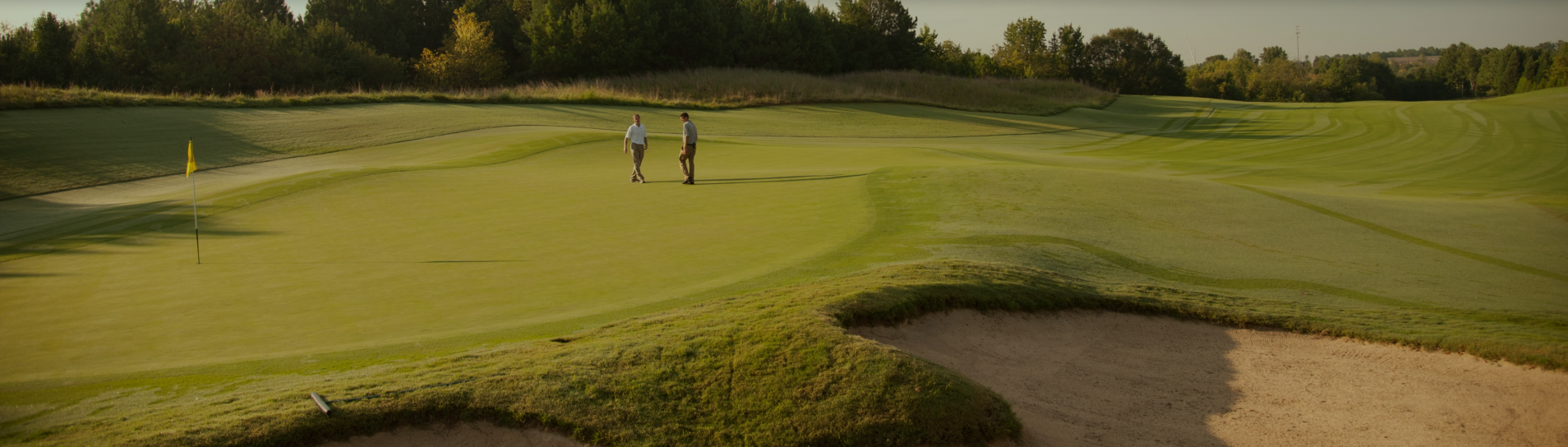
Would it be viable for Crystal Downs CC, an Alister Mackenzie design in Frankfort, Mich., to be maintained like a British golf course? To do so would take a change in climate and in maintenance practices, as well as a change in the mentality of the American golfer. Photo by Kyle Thompson

Staff, golfer expectations and climate
Greenkeeping in the U.K. is generally characterized by a small staff: six workers caring for a private 18-hole country club is an average staff — eight would constitute a large staff. In the U.S., a similar 18-hole facility might employ 16 to 20 workers on its maintenance staff during the peak season. Consequently, operating budgets for golf course maintenance are much lower in the U.K. than in the U.S.

From the top, expectations simply are different between the two settings. The owners and committees in the U.K. expect that their courses should be maintained with six people and that the expense for maintaining the golf course should be minimal. The membership and clientele know exactly what to expect from this level of maintenance, including the different playing conditions they will encounter throughout the year. In the U.S., by contrast, our clientele expect our courses to look and feel the same all year and be in excellent condition during the peak playing season.

With respect to turfgrass growing conditions, the U.K. and the northern U.S. can generally be described as temperate climates, amenable to cool-season turfgrass species such as bentgrass, fescue, bluegrass and ryegrass. However, there are very significant differences in rainfall, humidity and average temperatures within our temperate climate. Though subtle, the different climatic conditions between the U.K. and the U.S. affect how we cultivate and maintain desirable grasses at our respective locations.

One example of the subtle differences of our temperate climates can be seen in the winter. During the winter in much of the U.K., golf courses are green and playable, pending some frost delays or occasional snow, with daytime temperatures averaging in the 40s. A private club might spot treat for one species of snow mold — never treating all areas. In contrast, we are well aware of the problems winters can pose across the northern U.S., where winter diseases and winterkill can be the biggest agronomic challenge. Furthermore, because there is active turfgrass growth in the winter in the U.K., the fine, desirable cool-season grasses continue to grow and dominate the turfgrass populations. There might be only a few select locations in the U.S. that mirror those conditions.

Golf courses in the U.K. are generally in an almost ideal environment for cool-season grasses — sandy, well-drained soils.

Low input vs. optimum input
Golf course maintenance in the U.K. can be characterized by low inputs applied to a turfgrass system that is uniquely adapted to its environment. The U.K. presents an almost ideal environment for growing cool-season grasses — it’s no wonder golf originated there. The finest courses in the U.K. are, generally speaking, built on sandy, well-drained soils. Fine grasses such as fescue and bentgrass are very well adapted to the climate and conditions in the U.K. British courses use irrigation sparingly, allowing grasses to go dormant during the hot and dry periods of the summer. Fertilizer is also used sparingly, minimizing growth and organic matter accumulation that could change the very nature of the soil. The approach to course conditioning in the U.K. is ecological — requiring minimal inputs, and primarily dependent upon the soil conditions and the climate.

This low-input, ecology-driven approach to turfgrass maintenance strives to promote grasses that are naturally adapted to low-input maintenance practices — grasses that thrive with almost no input at all. This approach to maintenance is also characterized by not disturbing turfgrass roots, rhizomes, stolons and the soil. Greens might be lightly topdressed to keep the surface smooth and any thatch in check. The practices of verticutting, grooming, brushing and aeration are minimal. (A very good description of this low-input approach to maintenance in the U.K. can be found at the R&A Web site, under the link “The Open Road to Sustainability” at www.bestcourseforgolf.org/video/.

The heat of summer in the U.K., combined with limited irrigation and minimal surface disruption, causes the undesirable grasses, such as Poa annua, to wane from stress and disease. The desirable grasses, bentgrass and fescue, can go dormant in the summer and break dormancy when the weather changes. It is important for the greenkeeper in the U.K. to protect the desirable turfgrass from damage and disruption during periods of dormancy, since its ability to recuperate is seriously compromised under stress. Also, golf car stress is minimal in the U.K., compared with the prolific car usage in the U.S., helping to reduce mechanical damage, or wear.

Britain’s Alwoodley GC, built in 1904, was Alister Mackenzie’s first design.

Maintenance practices in the U.S., we know, present a very different story. They can be characterized by using the optimum inputs necessary to manage turfgrass and meet golfers’ expectations. The golfer in the U.S. expects a certain level of quality for the price that is paid. In order to meet these expectations, U.S. superintendents use all available resources, including the course’s revenue potential, to condition and present the golf course according to specific maintenance standards.

Sam McLean, Willie Nesbit and Peter Hampton of Bernhard and Co. along with Morris at the British Turfgrass Management Exposition.

However, this does not mean that an ecological approach would not work in the U.S., nor does it mean that we are not currently using ecological approaches as an integral part of our golf course management practices. Superintendents in the U.S. certainly work with their unique ecological settings. However, if golfers in the U.S. want something like they see in the U.K., we need to consider all of the variables in the equation. Beyond idealizing playability and slashing staff and expenditures, we need to be realistic about the possible outcomes of low-input maintenance, as well as golfers’ expectations related to such a change in maintenance philosophy if it were implemented in the U.S.

Low-input, ecological maintenance at home
Could low-input, ecology-driven maintenance be applied at my course? At your course? Maybe. However, one would have to realize that the results likely would be different from those we observe in the U.K. In other words, one should not automatically assume that U.K. conditions could be simulated in the U.S. transition zone, for example, by using British practices.

Just before we finished our course visit at Ganton Golf Club, I had a chance to speak one-on-one with Philip Baldock, the head greenkeeper. He told me that he is continually working to control Poa annua and to maintain the integrity of the course design and the playability that his members expect. He added that he has been working for several years to get the golf course in the condition we were seeing.

I told Baldock that I had encountered golfers at home who want to see U.K. maintenance practices and course conditioning implemented at Crystal Downs — adding that I manage a course that is predominantly Poa annua. I then asked him if it would be possible to make this transition by simply turning off the water and cutting back on fertilizer (to put a positive spin on the advice I was getting).

Baldock looked at me and said, “If I were to grab you by the neck and close off your windpipe, you would not have time to adapt to your new environment.” Translation: If you kill the turf you have, you won’t have much to cultivate, let alone play on. He added, “Getting a course in this condition is not as simple as turning off the tap.” Baldock was reiterating the idea that course conditioning in the U.K. is an ecological system, requiring a long-term commitment to maintain a golf course with minimal inputs where soil is managed carefully and the turfgrass is adapted to its unique setting.

Agronomic practices aside, would U.S. golfers really want the playing conditions afforded by low-input, ecological maintenance practices? A course could certainly look different and play differently than it does with optimum inputs and maintenance. Would U.S. golfers have patience for the prolonged, evolutionary process of changing the condition of soil and the composition of grasses? Furthermore, would golfers realize that the outcome of low-input maintenance in the U.S. would not necessarily produce similar results to course conditions they see in the U.K.?

There have been several attempts to institute British practices in the U.S., notably at newly constructed golf courses, with mixed results. And, it has generally failed where it has been tried in Northern California and Michigan — from an agronomic standpoint — mainly because of the virulence of Poa annua, among other variables. If the outcome of this approach to maintenance is mixed on new courses, what would it take to transition from an established golf course to the maintenances practices that are used in the U.K.? We would be venturing into uncharted territory.

Evolution and intelligent design
While the preferred course condition for most golfers is “fast and firm,” the methods for achieving those conditions can be radically different. In the U.K., the results are obtained with low-input, ecology-driven practices, whereas in the U.S., the results are achieved with optimum input, culturally driven maintenance practices. If golfers and decision-makers at courses in the U.S. would like to attempt a low-input ecological approach to achieve “fast and firm” conditions, it would be a pioneering effort.

Just as low-input, ecology-driven practices in Britain and optimum-input, culturally driven maintenance practices in America are different, all golf courses are different.

In the future, practical research involving low-input maintenance for golf courses could be studied across the U.S. It would certainly be a worthwhile endeavor and demands our full support — if only from economic and environmental points of view. However, there might be some methods to begin to address this issue at a facility in the U.S. Here are four possible approaches I proposed to the green committee at Crystal Downs:

• Implement a comprehensive change in current maintenance practices and conditioning of the golf course in order to allow the course to evolve into a natural state over an undetermined period of time.

• Test the low-input, ecological approach on two or three holes for several years, measuring golfer satisfaction and turfgrass viability.

• Build new “experimental” golf holes on the property to determine the most desirable grasses for our area.

• Continue with our current, optimum-maintenance inputs, changing the playability of the golf course with drainage, topdressing, mowing heights and aeration, along with judicious irrigation and fertilization practices — to provide faster and firmer playing surfaces that allow a variety of ground shots, pitches and bump-and-run shots.

Our committee agreed to continue maintaining the golf course with our current optimum cultural inputs.

GCSAA Golf Industry Show in Anaheim underscore the importance of differences that exist among golf courses and how they are maintained. A superintendent from Ireland asked Miller his preference for U.S. Open versus British Open conditioning. Miller did not state his preference at all. Rather, he told a story about how he got a double eagle on a par 4 as the ball rolled along the fairway, onto the green and into the cup — adding that the U.S. spectators cheered, while the Brits were silent, thinking to themselves that this shouldn’t happen.

Miller was saying that golf courses are different, and pose different challenges and strategies, and that all courses need not be maintained and set up the same way, or some
preferred way.

For now, time and history will tell the story of how courses across the U.S. might “evolve” by means of good research and the input of skilled superintendents.


Leo Feser Award candidate
This article is eligible for the 2008 Leo Feser Award, presented
annually since 1977 to the author of the best superintendent-written
article published in GCM during the previous year. Superintendents receive a $300 stipend for articles. Feser Award winners receive an all-expenses-paid trip to the Golf Industry Show, where they are recognized. They also have their names engraved on a plaque permanently displayed at GCSAA headquarters.


Michael D. Morris, CGCS, is a 22-year GCSAA member and the superintendent at Crystal Downs CC, Frankfort, Mich.

RECENT issues

January
2008

December
2007