

GCSAA publishes specialized information on a frequent basis that drills down on top advocacy issues and activities.
Mohawk Golf Club, located in the upstate capital region of New York, recently welcomed around 10 state legislative officials and staff for a half day walk and talk visit. Hosted by the Empire State Golf Alliance, including participation by numerous allied golf organizations in New York, the event showcased golf’s environmental, economic, social and educational value to the local community.
A brief tour of the property highlighted the use of best management practices and demonstrated numerous realities, starting with how low-lying areas of the golf course, including irrigation ponds, serve as runoff collection areas for the local neighborhood, a critical ecological service provided by the course. Eric Westervelt, golf course superintendent and a 29-year member of GCSAA, described how dense, healthy turfgrass filters out nutrients, pollutants and particulate matter from the runoff, and how buffer strips around the pond help improve water quality.
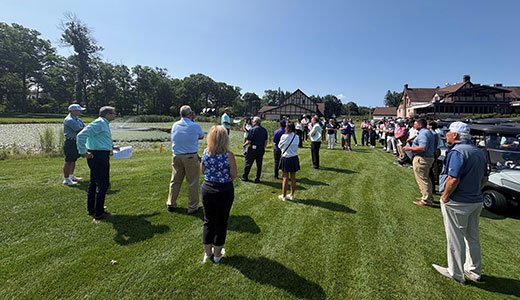
Westervelt also demonstrated how Spiio soil sensors buried in key locations throughout the golf course provide a subsurface picture of soil moisture, temperature and salinity, which helps guide irrigation decisions. When combined with an up-to-date irrigation system, the use of handheld moisture meters, weather station readings and selective hand watering, the policymakers in attendance quickly began to understand that golf courses don’t water indiscriminately. Quite the opposite in fact. Irrigating with intention to preserve water resources is the name of the game in today’s world of golf course management which was a key takeaway from the meeting.
As legislators were hearing about modern irrigation, they couldn’t help but notice another modern feature: the robotic mowers creeping down the fairway which led to the second stop of the tour. Here, Met GCSA Executive Director Mike McCall, CGCS, discussed a recent industry report on the state of electric and battery-powered equipment used on golf courses, including the ever-increasing usage of autonomous mowers. McCall highlighted the high quality of cut these mowers are now providing, freeing up maintenance staff to perform other duties as the mowers go about their work. As legislators raised questions and concerns about technology displacing workers, a special point of emphasis was made that, on a golf course, there is no shortage of work for humans to do. Technology was not going to replace jobs on New York’s 833 golf courses, but it certainly has the potential to make the work of the maintenance crew more efficient.
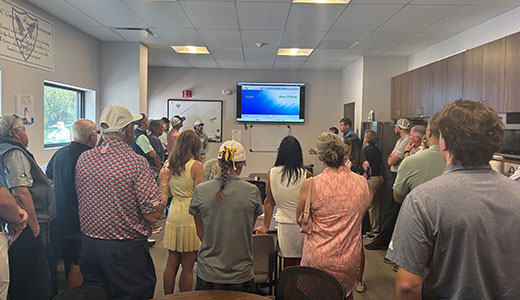
The tour continued along to the Mohawk maintenance shop for a look at some of the equipment used on the property. Inside, legislators also learned how data informs workflow decisions and job assignments. Charts and graphs on screens throughout the shop showed environmental conditions, historic averages and trends, and predictive modeling that helps Westervelt plan his crew’s work and keep the course in great shape and ready for events happening at the club week in and week out.
To conclude the tour, the group visited Mohawk’s practice range to hear how the club is engaging the local community through veterans and youth programing. Bud Abare, PGA HOPE ambassador, spoke about the challenges – both mental and physical – many veterans experience transitioning to civilian life, and how learning and playing the game of golf has helped him overcome these struggles. Siena Wheeler, a student at Bryant University who grew up in the Schenectady area, shared how pursuing a challenging sport like golf helped her grow as a young person. Thanks to junior golf programs, she developed her game through high school and earned a roster spot on Bryant’s Division I women’s golf team in 2025.
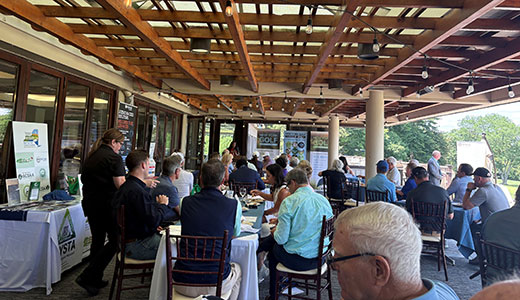
The event concluded with lunch at the clubhouse including comments by elected officials in attendance, ESGA president Tom Kaplun, Mohawk Golf Club General Manager Craig McClain, and more. Events such as this are key to demonstrating the value golf courses bring to communities and the numerous people from many different walks of life who are positively impacted by the industry.